
Did you know that while the global valve manifold box market has reached a valuation of USD 0.87 billion in 2026, component failure in corrosive environments still accounts for a significant portion of unplanned industrial downtime? You’ve likely felt the frustration of sourcing components only to find that documentation gaps or material impurities compromise your system’s integrity. Identifying a 3-valve manifold supplier that balances technical expertise with a robust inventory of exotic alloys is no longer just an operational preference; it’s a requirement for safety and longevity.
It’s clear that you prioritize secure, leak-proof instrumentation connections that can withstand the most hostile process conditions. This article provides the technical framework you need to select the right configuration and material grade for your differential pressure transmitter setups. We’ll explore the implications of the new ISO 22109:2026 standards, evaluate the performance of alloys like Monel and Titanium, and ensure your procurement process aligns with the highest regulatory benchmarks for high-pressure systems. By the end of this guide, you’ll possess the knowledge to secure components that offer an extended service life and full traceability.
Key Takeaways
- Understand the essential mechanics of how block and equalizer valves protect sensitive differential pressure transmitters from over-pressure damage.
- Identify the technical criteria for moving beyond 316L stainless steel to high-performance alloys like Duplex, Monel, and Titanium in corrosive environments.
- Learn how to evaluate a 3-valve manifold supplier based on their hydrostatic, pneumatic, and helium leak testing protocols for high-pressure applications.
- Discover the impact of 2026 industry standards on compliance and traceability documentation for critical instrumentation connections.
- Master the selection process to ensure secure, leak-proof performance and extended service life in demanding industrial process conditions.
The Essential Role of 3-Valve Manifolds in Process Instrumentation
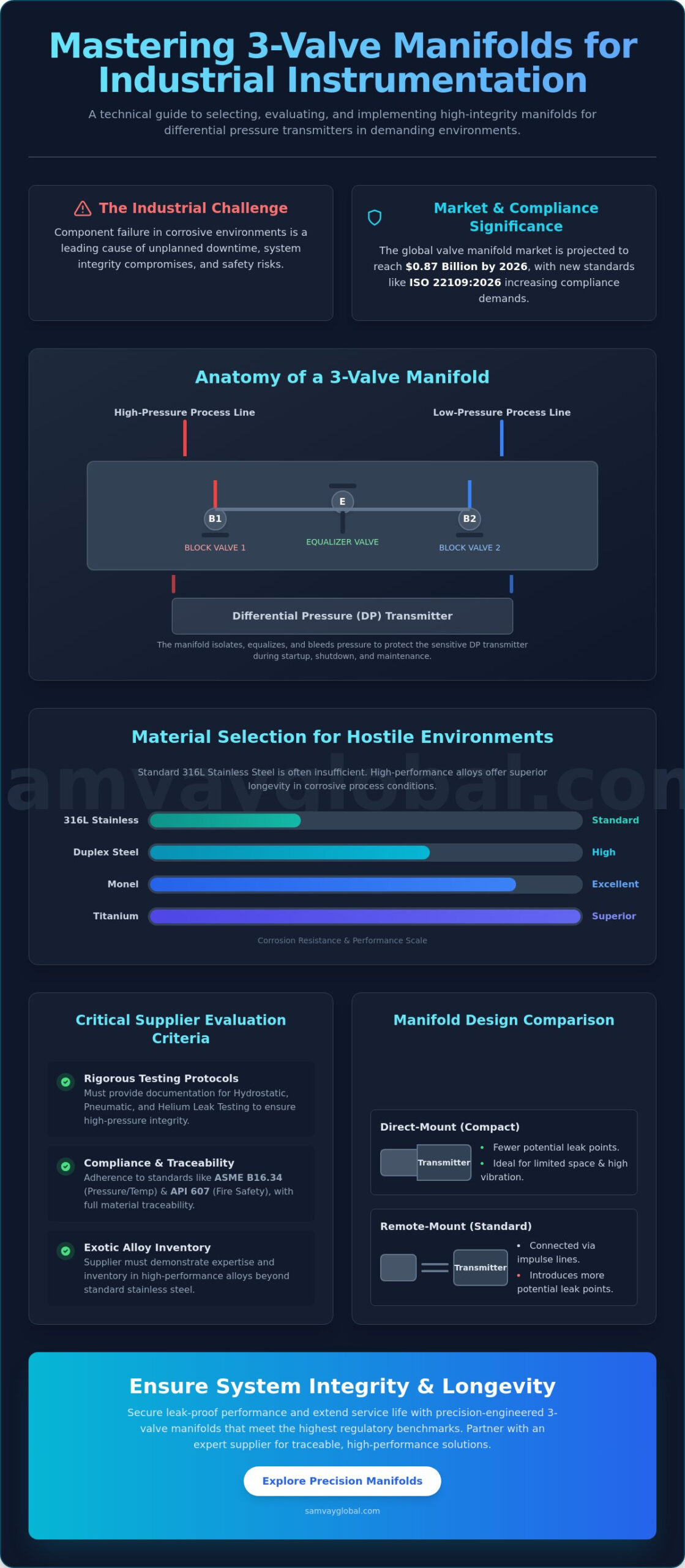
A 3-valve manifold is an integrated fluid control device designed to isolate, equalize, and bleed differential pressure instruments. It serves as the primary interface between process lines and sensitive instrumentation. Its primary function is the protection of transmitters from over-pressure conditions that typically occur during system startup, shutdown, or routine maintenance. By consolidating multiple valve functions into a single, high-precision body, these manifolds eliminate the need for complex discrete piping. This streamlined design reduces the total number of connections, which directly lowers the risk of fugitive emissions and potential leak paths in high-stakes environments.
The standard configuration of this device includes two block valves and one equalizer valve. The block valves provide absolute isolation from the process fluid, while the equalizer valve balances the pressure between the high and low sides of the transmitter. Selecting a technically proficient 3-valve manifold supplier is essential for ensuring these components meet the rigorous demands of modern industrial standards. A reliable partner provides the assurance that every manifold valve is machined to exact tolerances, maintaining system integrity even under extreme pressure cycles.
Precise control of these valves is foundational to accurate pressure measurement. Without the ability to equalize pressure across the sensor diaphragm before opening the block valves, the resulting pressure spike could permanently damage or de-calibrate the instrument. This makes the 3-valve manifold a non-negotiable component for any facility prioritizing operational uptime and instrument longevity.
Standard vs. Compact Manifold Designs
Traditional 3-valve setups often utilize a remote-mount design. These are typically installed on a pipe stand or wall bracket and connected to the transmitter via impulse lines. While effective, they introduce more potential leak points. In contrast, compact direct-mount designs allow the manifold to bolt directly to the transmitter face. This setup is ideal for applications where space is limited or where high vibration risks could loosen traditional threaded connections. Choosing between these depends on your specific installation environment and the required accessibility for maintenance personnel.
Integration with Differential Pressure (DP) Transmitters
The manifold interfaces directly with the high and low-pressure process lines to facilitate accurate DP readings. A critical step in this integration is zero-point calibration. By closing the block valves and opening the equalizer valve, technicians can verify that the transmitter reads zero when pressure is equal on both sides. Most industrial setups utilize standard NPT threaded connections or flange-to-flange interfaces to ensure a secure fit. Your 3-valve manifold supplier should offer various connection standards to match your existing infrastructure, ensuring a seamless and leak-proof integration with your instrumentation suite.
Engineering Anatomy: Block, Equalize, and Bleed Functions
The internal architecture of a 3-valve manifold is engineered for precision and safety. The two block valves serve as the primary line of defense. They ensure absolute isolation of the process fluid from the instrument. This is critical when a transmitter requires removal or calibration. The equalizer valve sits between the high and low process lines. Its role is to balance the pressure, preventing the one-sided pressure spikes that destroy sensitive sensors. While many standard 3-valve designs focus on block and equalize, a bleed or vent option is often integrated to safely release trapped pressure before the instrument is fully disconnected.
Reliability depends on adherence to global engineering standards. Quality units are designed to ASME B16.34 specifications for pressure and temperature ratings. In many high-risk sectors, API 607 fire safety certification is also required. These mechanical safeguards are essential for accurate industrial pressure measurement, as even minor pressure imbalances can lead to significant reporting errors. Working with a dedicated 3-valve manifold supplier ensures that these compliance standards are met through rigorous material testing and documented traceability.
Operating Sequence for Safe Maintenance
Maintaining a pressurized system requires a methodical approach to prevent equipment damage. Operators must follow a specific sequence. First, close the high-pressure block valve to initiate isolation. Second, open the equalizer valve. This action balances the transmitter and prevents a differential pressure overload. Finally, close the low-pressure block valve for full system isolation. This process allows technicians to safely perform zero-point checks or remove the transmitter for bench testing. If you are looking for high-performance components, you might consider browsing the specialized manifold valve inventory available from established manufacturers.
Valve Stem and Packing Technologies
The longevity of a manifold depends on its internal components. Non-rotating tip designs are the industry benchmark. They stop the stem from rotating against the seat, which prevents galling and extends the life of the valve. Packing materials also vary based on the application. PTFE is excellent for standard chemical resistance, while graphite is the standard for high-temperature service. Many manufacturers now include color-coded dust caps. These help field operators quickly identify valve functions, reducing the chance of human error during complex operations. This level of detail is why choosing a reputable 3-valve manifold supplier is a cornerstone of facility safety.
Material Excellence: Selecting Manifolds for Hostile Environments
Standard 316L stainless steel often serves as the baseline for instrumentation, but it’s not a universal solution for every process environment. In offshore platforms or chemical processing plants, chloride-rich or acidic media can quickly compromise standard alloys. This is where the expertise of a 3-valve manifold supplier becomes vital. They provide access to high-performance materials like Duplex and Super Duplex steel, which offer superior resistance to pitting and stress corrosion cracking compared to traditional austenitic grades. These materials don’t just provide strength; they ensure the long-term reliability of the entire measurement loop.
For extreme chemical resistance, nickel alloys like Monel, Hastelloy, and Inconel are required. Monel is particularly effective in hydrofluoric acid and marine applications, while Hastelloy handles aggressive hydrochloric and sulfuric acids. In weight-critical subsea installations, titanium manifolds offer an unmatched strength-to-weight ratio and immunity to seawater corrosion. Understanding these metallurgical nuances is as important as mastering the 3-valve manifold operation itself, as the best mechanical design will still fail if the material isn’t suited to the media.
Corrosion Resistance for Oil, Gas, and Chemical Processing
Sour gas (H2S) environments require strict adherence to NACE MR0175/ISO 15156 standards to prevent sulfide stress cracking. In offshore settings, preventing chloride stress corrosion cracking (CSCC) is a primary concern for maintenance engineers. Inconel’s ability to form a stable protective oxide layer ensures an exceptionally long service life in highly acidic or high-temperature media. Choosing the correct alloy prevents premature component failure and protects the massive capital investment of your instrumentation suite.
Material Traceability and Quality Assurance
Quality assurance in critical infrastructure isn’t optional. Every component must be backed by a Material Test Report (MTR) that confirms its chemical and physical properties. A reputable 3-valve manifold supplier ensures compliance with EN 10204 3.1 standards, providing full traceability from the raw material stage to the finished product. To verify these claims, manufacturers often employ Positive Material Identification (PMI) testing during the production process. This non-destructive method confirms the elemental composition of the alloy, ensuring the manifold you install is exactly what was specified in the engineering phase. This systematic approach to quality builds the trust necessary for long-term industrial partnerships.
Critical Evaluation Criteria for a 3-Valve Manifold Supplier
Selecting a 3-valve manifold supplier involves much more than comparing unit costs or lead times. It requires a rigorous audit of their technical infrastructure and quality control systems to ensure they can meet the high-stakes demands of your facility. A supplier’s manufacturing capability is the primary filter for selection. They must demonstrate the expertise to handle not only standard 316L stainless steel but also the complex machining requirements of Nickel Alloy and Titanium instrumentation tube fittings. High-pressure ratings up to 10,000 psi demand a level of precision that only seasoned manufacturers with advanced CNC capabilities can provide.
Testing protocols represent the next pillar of evaluation. You should prioritize a partner that performs comprehensive hydrostatic and pneumatic testing as part of their standard quality assurance process. For critical gas applications where fugitive emissions are a concern, helium leak testing provides the ultimate assurance of system integrity. Beyond the factory floor, consider the supplier’s global logistics footprint. The ability to manage complex export documentation and deliver to remote project sites, such as offshore platforms or isolated refineries, ensures your project timeline remains intact. Technical support is equally vital. Having direct access to engineering expertise allows for the development of custom manifold configurations that solve unique spatial or process challenges.
A dedicated partner provides more than just hardware; they offer a narrative of trust built through transparency and technical competence. This collaborative approach often leads to more efficient system designs and reduced long-term maintenance costs. When you evaluate a 3-valve manifold supplier, you aren’t just buying a component; you’re securing a link in your process safety chain.
Pressure and Temperature Rating Verification
Verification is the cornerstone of industrial safety. Ensure that pressure ratings, typically ranging from 6,000 psi to 10,000 psi, are validated by documented third-party testing rather than just internal simulations. It’s essential to evaluate performance curves across the full operating temperature range of your facility. Thermal cycling can stress the bonnet-to-body seal, so you must verify that the design maintains a leak-proof seal under rapid temperature fluctuations. This level of scrutiny prevents premature component failure in the field.
Supplier Compliance and Certification Checklist
A reliable institution operates under a strict framework of global standards. ISO 9001:2015 certification for quality management systems is a baseline requirement for any professional manufacturer. For those operating in European markets, PED (Pressure Equipment Directive) compliance is mandatory for high-pressure equipment. You can evaluate our manufacturing certifications to see how we align with these international benchmarks. This transparency ensures that every component, from a check valve to a manifold, meets necessary safety criteria. If you’re ready to secure your instrumentation system, you can consult with our engineering team for a technical review of your specific requirements.
Samvay Fluid Tekniks Inc: Your Global Partner for Precision Manifolds
Navigating the technical complexities of fluid control requires more than just a vendor; it demands a strategic ally. Samvay Fluid Tekniks Inc serves as a premier 3-valve manifold supplier, bridging the gap between advanced metallurgy and practical engineering. Our institutional stability is built on a foundation of unwavering professional authority. We maintain an extensive inventory of manifolds in Duplex Steel, Nickel Alloy, and Titanium. These materials aren’t just options; they’re the standard for industries that can’t afford the cost of component failure in hostile environments.
Refineries and offshore facilities face unique operational hurdles that off-the-shelf components can’t always solve. Samvay Fluid Tekniks Inc specializes in providing customized engineering solutions that address specific pressure, temperature, and corrosion challenges. Our global supply chain is optimized for industrial reliability. This ensures that every high-pressure pipe fitting or manifold valve arrives with the necessary certifications and documentation to meet your project’s stringent requirements. We prioritize trust and long-term commitment, positioning Samvay Fluid Tekniks Inc as a reliable anchor in the demanding industrial landscape.
Why Leading Global Industries Choose Samvay Fluid Tekniks Inc
Our reputation is backed by decades of expertise in high-pressure instrumentation valve manufacturing. Samvay Fluid Tekniks Inc has refined production processes to ensure that every unit leaving our facility adheres to rigorous quality control standards. These protocols often exceed standard industry requirements, providing an extra layer of safety for your critical systems. We adopt a customer-focused approach that views every transaction as a partnership. This philosophy ensures that Samvay Fluid Tekniks Inc remains invested in your project’s success long after the final installation is complete.
Seamless Procurement and Technical Integration
Procurement in the industrial sector is a complex process that involves multiple stakeholders. Samvay Fluid Tekniks Inc supports engineers from the initial design specification phase through to final installation. Our team provides the technical data and engineering support necessary to integrate our manifolds into your existing infrastructure seamlessly. We’ve also streamlined our export processes to serve international industrial sectors efficiently. This reduces lead times and ensures that your facility remains compliant with local and global regulations. If you’re ready to enhance your system’s performance, you can contact Samvay Fluid Tekniks Inc for a technical consultation on your manifold requirements.
Securing System Integrity in High-Pressure Environments
Selecting the correct instrumentation interface is a critical decision that impacts the safety and efficiency of your entire process loop. The synergy between precise mechanical design and advanced metallurgy is the only way to ensure long-term reliability in hostile conditions. By mastering the functional nuances of block and equalize sequences and prioritizing high-performance alloys like Duplex or Titanium, you protect both your sensitive equipment and your personnel. Partnering with a technically proficient 3-valve manifold supplier is the final step in achieving full regulatory compliance and operational peace of mind.
Samvay Fluid Tekniks Inc provides the stability and expertise required for these high-stakes applications. Our ISO 9001:2015 certified manufacturing facility specializes in Duplex and Nickel Alloy components, ensuring your system withstands aggressive corrosive media. With extensive global export experience in the oil and gas sectors, Samvay Fluid Tekniks Inc understands the logistical and technical precision your projects demand. We invite you to Request a Technical Quote for 3-Valve Manifolds and discover how our commitment to quality serves as a reliable anchor for your industrial infrastructure. It’s time to secure your instrumentation with components built for resilience.
Frequently Asked Questions
What is the difference between a 3-valve and a 5-valve manifold?
A 3-valve manifold utilizes two block valves and one equalizer valve to isolate and balance pressure for a transmitter. In contrast, a 5-valve manifold includes two additional vent or bleed valves that allow for the safe release of trapped pressure to the atmosphere or a closed system. While the 3-valve design is standard for liquid service, the 5-valve configuration is often preferred for gas applications where pressure entrapment is a safety concern.
Can a 3-valve manifold be used for steam applications?
Yes, 3-valve manifolds are suitable for steam service provided they’re specified with high-temperature packing materials like graphite. It’s also standard engineering practice to install a siphon or condensate pot between the process line and the manifold to protect the transmitter from direct steam contact. Your 3-valve manifold supplier should confirm that the selected alloy can handle the specific thermal stresses of your steam system.
How do I know if I need a direct-mount or remote-mount 3-valve manifold?
Choose a direct-mount manifold when you want to minimize leak paths by bolting the device directly to the transmitter face. This is ideal for compact, vibration-free installations. Remote-mount manifolds are necessary when the process temperature exceeds the transmitter’s limits or when the instrument must be located in a more accessible area for maintenance. The decision depends on your facility’s layout and the thermal profile of the process fluid.
What are the common failure points in a 3-valve manifold?
Common failure points include seat galling, packing leaks, and degradation of the bonnet-to-body seal. These issues are typically caused by over-tightening the valves or choosing a material that isn’t compatible with the process media. Utilizing high-performance alloys like Duplex or Monel can mitigate these risks in corrosive environments, ensuring the long-term integrity of the measurement loop.
Is NACE compliance mandatory for all 3-valve manifolds in oil and gas?
NACE MR0175/ISO 15156 compliance is mandatory only for sour service applications where hydrogen sulfide (H2S) is present. This standard ensures that the materials used are resistant to sulfide stress cracking. While not required for all oil and gas projects, many engineers specify NACE-compliant components as a baseline safety measure to ensure maximum resilience across various process conditions.
How often should 3-valve manifolds be tested or maintained?
Maintenance intervals depend on the severity of the process and your facility’s internal safety standards. Most professional guidelines suggest a functional leak test and zero-point calibration check at least once every twelve months. In high-cycle or highly corrosive applications, more frequent inspections are necessary to identify potential wear before it leads to a system failure.
What pressure ratings are standard for instrumentation manifolds?
The standard pressure rating for most industrial instrumentation is 6,000 psi (413 bar). For more demanding hydraulic or high-pressure gas systems, 10,000 psi (689 bar) ratings are commonly used. It’s essential to verify these ratings against the operating temperature, as the pressure-holding capacity of a 3-valve manifold supplier’s product will decrease as the temperature rises.
Why is a non-rotating tip important in a manifold valve?
A non-rotating tip ensures that the valve stem does not grind against the seat during the closing process. This design eliminates the friction that causes seat galling, which is a primary cause of internal valve leakage. By facilitating a purely linear closure, the non-rotating tip ensures a bubble-tight seal and significantly extends the service life of the manifold valve in high-pressure service.