

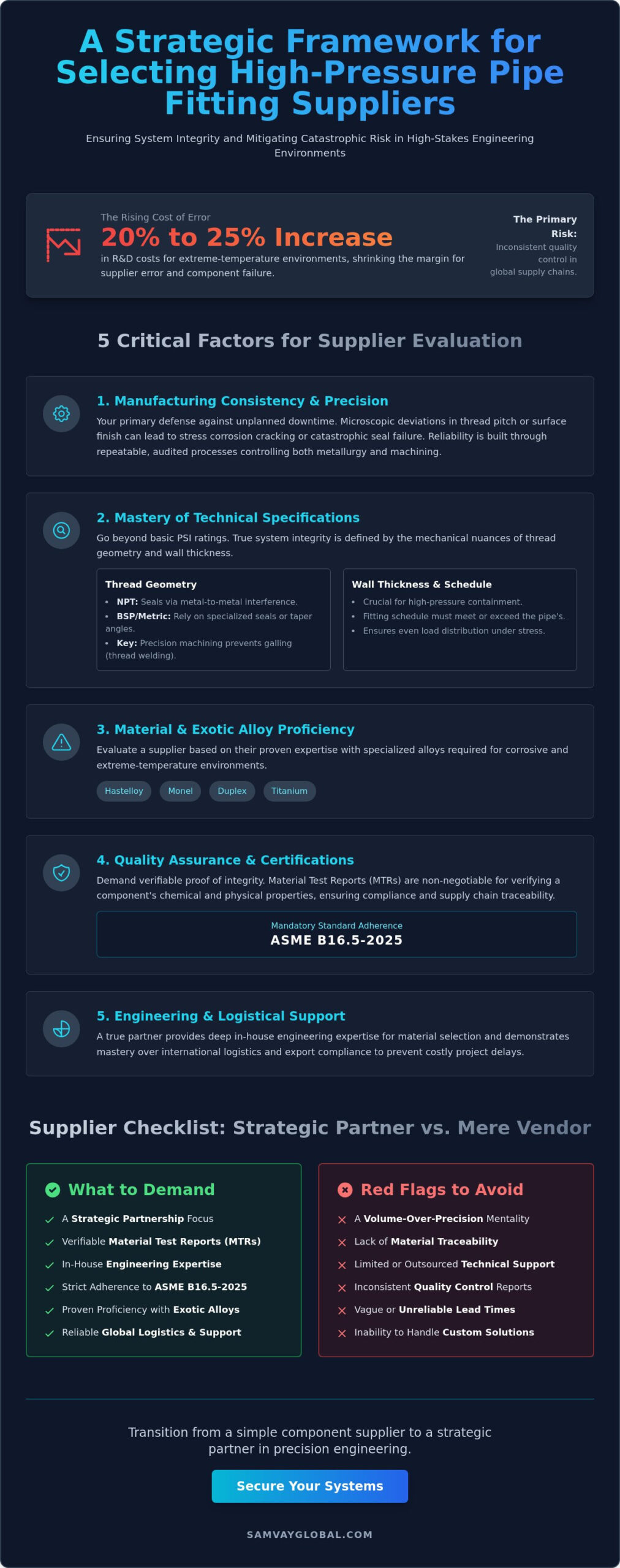
A single sub-standard fitting in a high-pressure system isn’t just a minor maintenance headache; it’s a catastrophic liability that can halt critical production for weeks. As research and development costs for extreme-temperature environments rise by 20% to 25%, the margin for error in selecting a high pressure pipe fitting supplier has never been thinner. You likely recognize that the risk of system failure often stems from inconsistent quality control in global supply chains, especially when sourcing exotic alloys like Hastelloy or Monel. It’s a constant struggle to balance immediate project deadlines with the absolute necessity of industrial safety and long-term reliability.
This technical guide provides the strategic framework you need to secure leak-proof connections and ensure performance in the most corrosive environments. We’ll show you how to handle procurement complexities while adhering to the mandatory ASME B16.5-2025 standards that took effect on January 1. You’ll gain a clear roadmap for identifying partners who prioritize precision engineering and ethical service. This approach allows you to streamline your operations from a single, authoritative source that understands the high-stakes nature of your engineering and manufacturing requirements.
Key Takeaways
- Understand why manufacturing consistency is the primary defense against system downtime and catastrophic failure in high-stakes engineering environments.
- Master the technical nuances of thread types and wall thickness ratings to ensure leak-proof pressure containment in your most demanding systems.
- Learn how to evaluate a high pressure pipe fitting supplier based on their proficiency with specialized alloys like Duplex, Monel, and Titanium.
- Decode essential industrial certifications and traceability reports to verify material integrity and maintain compliance across your global supply chain.
- Discover how to transition to a strategic partnership that prioritizes technical precision and long-term industrial reliability over mere volume.
Critical Factors in Selecting a High Pressure Pipe Fitting Supplier
Industrial procurement is not merely about sourcing components; it’s about managing operational risk. In high-stakes environments, the precision of a fitting directly dictates the safety of the entire infrastructure. Selecting a high pressure pipe fitting supplier requires a cold evaluation of their manufacturing tolerances and material integrity. Even a microscopic deviation in thread pitch or surface finish can lead to stress corrosion cracking or catastrophic seal failure. You need a partner that views precision as a non-negotiable standard rather than a variable target.
Manufacturing consistency is your primary defense against unplanned downtime. When a facility integrates hundreds of connections, a single outlier in a batch of High Pressure Pipe Fittings can compromise a multi-million dollar project. Reliability is built through repeatable, audited processes. It’s essential to partner with a supplier that maintains rigorous control over both metallurgy and machining. This ensures that every component, whether it’s an Instrumentation Tube Fitting or a specialized adapter, performs identically under maximum load. This level of uniformity is what prevents the leaks that lead to environmental hazards and costly repairs.
Your operations likely require a mix of standard inventory and custom instrumentation solutions. A versatile supplier offers a comprehensive range of types of pipe fittings, alongside critical components like Manifold Valves and Check Valves. End-to-end compatibility between valves and fittings reduces the risk of mismatched tolerances. This synergy is particularly important as the industry moves toward the stricter ASME B16.5-2025 standards, which became mandatory on January 1, 2026. These updated regulations demand more precise material specifications and enhanced manufacturing standards to improve sealing performance.
Engineering Authority and Technical Support
Technical documentation is the backbone of industrial integrity. You shouldn’t view Material Test Reports (MTRs) as optional paperwork; they’re the verifiable proof of a component’s chemical and physical properties. An authoritative high pressure pipe fitting supplier provides deep in-house engineering expertise to help you select the right materials for specific pressures. This technical documentation is just as vital as the physical component itself. It ensures that every Ball Valve or fitting you install meets the exact requirements of your hostile industrial environment.
Global Supply Chain and Logistics Reliability
Project timelines often hinge on a supplier’s ability to navigate international logistics. In a globalized market, a supplier must demonstrate mastery over export compliance and international shipping regulations. This expertise prevents costly delays at customs that can derail a project’s critical path. While global reach provides necessary scale, localized technical support ensures you have access to expert guidance when challenges arise on-site. A reliable supplier acts as a steadfast guide, handling both standard requirements and specialized logistical challenges with equal competence.
Technical Specifications: Beyond PSI and Thread Types
Technical excellence begins where standard catalogs end. While PSI ratings provide a baseline, the mechanical nuances of thread geometry and wall thickness define the long-term success of a high-pressure system. A reputable high pressure pipe fitting supplier understands that thread selection isn’t just about compatibility; it’s about sealing mechanics. NPT threads create a seal through metal-to-metal interference, which requires precise machining to prevent leaks. In contrast, BSP and Metric profiles often rely on specialized seals or specific taper angles to maintain integrity under stress. Precision-machined tapered threads are essential because they ensure even load distribution across the engagement area, significantly reducing the risk of galling. This is a common failure point where friction causes thread surfaces to weld together during assembly, making future maintenance impossible.
Wall thickness and schedule ratings are equally critical for pressure containment. It’s not enough to match the pipe size; the fitting’s schedule must meet or exceed the system’s requirements to prevent wall thinning under high-velocity flow. For permanent installations, you’ll need to choose between butt weld and socket weld fittings. Butt welds provide a smooth internal bore that minimizes turbulence and erosion, which is ideal for high-flow systems. Socket welds are often preferred in confined spaces for their ease of alignment, though they require careful installation to avoid crevices where corrosive media might gather. Selecting the right configuration requires deep technical knowledge, and you can find specialized High Pressure Pipe Fittings designed to meet these exact engineering tolerances.
Pressure Ratings and Safety Factors
Working pressure represents the maximum sustained load a component can handle, while burst pressure is the theoretical point of structural failure. Industrial safety factors, often 4:1, account for pressure surges and material fatigue over time. It’s vital to remember that temperature fluctuations directly impact these ratings. As temperatures rise, the allowable working pressure of a fitting decreases because the material begins to soften. Hydrostatic testing serves as a non-negotiable quality standard where components are pressurized to verify structural integrity before they ever reach the field.
Fitting Configurations for Complex Instrumentation
Modern instrumentation panels demand high-density layouts, making compact design a necessity rather than a luxury. Hex nipples, couplings, and adaptors serve as the fundamental building blocks for efficient manifold systems. When your system requires flow control between different pipe sizes, swage nipples are generally superior to standard reducing bushings. They offer a more gradual transition and higher structural strength, which is vital in high-vibration environments. Working with an experienced high pressure pipe fitting supplier ensures you have access to these specialized configurations, allowing for streamlined procurement and more resilient system architectures.
Material Selection: Stainless Steel vs. Exotic Alloys
Choosing the correct material is a foundational decision that dictates the lifespan of your high-pressure system. While 316 Stainless Steel is often considered the industry baseline, it isn’t a universal solution for every hostile environment. In applications involving high concentrations of chlorides or extreme temperatures, 316 can succumb to localized pitting or stress corrosion cracking. A specialized high pressure pipe fitting supplier provides the expertise to identify when a system requires an upgrade to more resilient alloys. This transition is often the difference between a system that lasts decades and one that fails within months of commissioning.
The rise of Duplex and Super Duplex steel has transformed subsea and offshore operations. These materials offer roughly twice the yield strength of standard austenitic stainless steels, allowing for thinner wall sections and reduced weight without compromising pressure containment. For environments involving aggressive chemical processing, Nickel Alloys become essential. Monel Instrumentation Tube Fittings are the standard for hydrofluoric acid and marine applications, while Hastelloy Instrumentation Tube Fittings provide unmatched resistance to oxidizing and reducing agents. In extreme thermal environments, Inconel Instrumentation Tube Fittings maintain their structural integrity where other metals would oxidize or creep.
When strength-to-weight ratios are the primary engineering constraint, Titanium Instrumentation Tube Fittings offer the ultimate solution. Titanium’s exceptional corrosion resistance in seawater and its ability to withstand high temperatures make it indispensable for advanced aerospace and deep-sea exploration. Your high pressure pipe fitting supplier should maintain a robust inventory of these exotic materials to ensure your procurement process remains streamlined, even for the most specialized project requirements.
Corrosion Resistance in Hostile Environments
Identifying the right alloy for sour gas (H2S) environments is a matter of safety and compliance. In these settings, materials must meet NACE MR0175/ISO 15156 standards to prevent sulfide stress cracking. Chloride stress corrosion cracking remains a primary threat in marine applications, where salt-laden air can quickly degrade standard stainless steel. For high-temperature chemical processing, selecting an alloy with high chromium and molybdenum content is vital. These elements form a protective oxide layer that shields the underlying metal from corrosive attack, ensuring long-term reliability in volatile conditions.
Metallurgical Integrity and Traceability
Heat code traceability is a non-negotiable requirement for high-pressure components. Every fitting must be traceable back to its original melt shop to verify its chemical and mechanical properties. Specialized heat treatments, such as solution annealing, are often employed to enhance the mechanical properties of fittings and ensure a uniform grain structure. It’s critical to verify that materials meet the precise chemical composition requirements of ASTM standards, such as ASTM A182 for forged fittings or ASTM A479 for bar stock. These standards define the allowable ranges for elements like carbon, nickel, and molybdenum, ensuring the material performs exactly as engineered under maximum pressure.
Evaluating Quality Assurance and Industrial Certifications
Quality assurance in the high-pressure sector is not a subjective claim; it’s a documented history of metallurgical and mechanical verification. When you evaluate a high pressure pipe fitting supplier, you aren’t just buying metal. You’re investing in a quality management system that ensures every component performs predictably under stress. ISO 9001 has long been the baseline, but the transition to ISO 9001:2026 brings new focus to digital transformation and supply chain resilience. A supplier that stays ahead of these revisions demonstrates a proactive commitment to industrial reliability that goes beyond mere volume. This systemic approach is what prevents the catastrophic failures that originate from inconsistent manufacturing processes.
Material certifications provide the essential transparency required for high-stakes engineering. Understanding the distinction between EN 10204 3.1 and 3.2 reports is critical for project compliance. A 3.1 certificate is issued by the manufacturer’s own quality department, while a 3.2 report requires validation by an independent third-party inspector (TPI). For critical subsea or high-temperature applications, TPI validation is often a non-negotiable requirement. It provides an extra layer of security, confirming that the Nickel Alloy Instrumentation Tube Fitting or Duplex Steel Instrumentation Tube Fitting you receive matches the exact chemical profile specified in your order.
Precision testing protocols like helium leak tests and hydrostatic verification offer the final proof of integrity. While hydrostatic tests confirm structural strength, helium leak detection identifies microscopic paths that liquid testing might miss. This is especially vital for instrumentation systems where even a molecular-level leak can compromise sensor accuracy or lead to hazardous gas accumulation. To ensure your systems meet these rigorous benchmarks, it’s essential to partner with a high pressure pipe fitting supplier that provides comprehensive testing documentation as a standard practice.
Compliance with Global Industry Standards
Navigating global piping codes requires a supplier with deep regulatory expertise. ASME B31.3 is the definitive standard for process piping, and compliance ensures your system is engineered for safe operation. In the oil and gas sector, NACE MR0175 compliance is vital to prevent sulfide stress cracking in sour service environments. If you’re operating in North American markets, you must also verify the Canadian Registration Number (CRN) for your fittings. This registration confirms that the design has been reviewed and accepted by provincial safety authorities, allowing for legal installation across various jurisdictions.
The Supplier Audit Process
A technical supplier audit is your best opportunity to vet a manufacturer’s raw material sourcing. You should ask specific questions about their vendor qualification process and how they handle metallurgical variances. Evaluating their internal traceability system reveals how quickly they can isolate a batch if a defect is discovered. Comprehensive quality documentation doesn’t just provide peace of mind; it significantly streamlines the project handover process. When every Ball Valve and fitting is accompanied by a complete data book, commissioning becomes a methodical, efficient exercise rather than a logistical hurdle.
Samvay Fluid Tekniks: Your Global Partner for High-Pressure Solutions
Samvay Fluid Tekniks Inc operates as a cornerstone of industrial reliability, providing a legacy of precision that spans global markets. As a premier high pressure pipe fitting supplier, we understand that the integrity of your fluid system depends on the synergy between every individual component. Our manufacturing philosophy prioritizes technical authority and ethical service, ensuring that each fitting is engineered to withstand the most demanding operational stresses. We don’t just supply parts; we offer a stable partnership built on a deep understanding of high-stakes engineering requirements.
Technical excellence at Samvay Fluid Tekniks Inc is defined by our unmatched expertise in exotic metallurgy. While many providers focus on standard stainless steel, we maintain specialized production capabilities for Duplex Steel Instrumentation Tube Fittings and Nickel Alloy Instrumentation Tube Fittings. Our mastery of materials like Monel, Hastelloy, and Inconel allows us to serve industries where chemical resistance is a critical safety factor. By maintaining control over the entire manufacturing process, from raw material vetting to final precision machining, we ensure that every component meets the rigorous standards discussed in earlier sections of this guide.
The true advantage of partnering with Samvay Fluid Tekniks Inc lies in the seamless integration between our valves and fittings. Whether your system requires a Ball Valve for quick shut-off or a Check Valve to prevent backflow, our components are designed to work in perfect unison. This end-to-end compatibility eliminates the risks associated with mismatched tolerances and inconsistent quality control. Our commitment to industrial safety means you receive a complete solution from a single, authoritative source that prioritizes long-term reliability over mere production volume.
Comprehensive Product Range for Critical Applications
Our product portfolio is engineered for diversity and performance. We offer a wide array of high-pressure ball, check, and needle valves designed for precision fluid control. For complex systems, our Manifold Valves provide streamlined operation and reduced leak paths, which is essential for modern instrumentation panels. We also recognize that unique engineering challenges often require customized fitting solutions. Our technical team works closely with clients to develop bespoke components that meet specific pressure ratings and geometric constraints without compromising structural integrity.
Global Reach with Personalized Technical Support
Supporting international projects requires more than just logistical capability; it requires a rapid response and a deep understanding of global compliance. Samvay Fluid Tekniks Inc supports projects worldwide by combining extensive export experience with personalized technical guidance. We act as a steadfast guide for our clients, helping them navigate the complexities of exotic metallurgy and high-pressure seals. To see how our expertise can secure your next project, you can Explore our full range of high-pressure pipe fittings and instrumentation valves at Samvay Fluid Tekniks Inc.
Securing the Future of Industrial Fluid Systems
The industrial landscape of 2026 demands a shift toward higher standards of metallurgical integrity and manufacturing precision. As we’ve explored, meeting the mandatory requirements of ASME B16.5-2025 and navigating the complexities of exotic alloy selection are essential steps for any strategic buyer. A reliable high pressure pipe fitting supplier must provide more than just hardware; they must deliver technical documentation and uncompromising quality control that protects your infrastructure from catastrophic failure. This guide has detailed why thread geometry, material traceability, and the synergy between valves and fittings are the ultimate defenses in hostile environments.
Samvay Fluid Tekniks Inc stands as a global leader in this demanding field. We specialize in the precision engineering of instrumentation valves and fittings crafted from advanced alloys like Monel, Hastelloy, and Inconel. Our status as a global exporter ensures that your projects receive world-class components regardless of their geographical location. By choosing a partner dedicated to technical authority and ethical service, you ensure the long-term resilience of your high-pressure systems. Partner with Samvay Fluid Tekniks Inc for your high-pressure instrumentation needs and secure the stability your industrial operations require for the years ahead.
Frequently Asked Questions
What defines a pipe fitting as ‘high pressure’ in an industrial context?
A pipe fitting is typically classified as high pressure when it’s engineered to withstand working pressures of 3,000 PSI or higher. These components are usually forged rather than cast to ensure the structural integrity required for heavy-duty industrial applications. The classification is governed by standards such as ASME B16.11, which dictates the wall thickness and material requirements for various pressure classes to ensure safe operation under load.
How do I choose between NPT and BSP threads for a high-pressure system?
Choosing between NPT and BSP threads depends primarily on your existing infrastructure and geographic standards. NPT threads are the standard in North America and create a seal through metal-to-metal interference. BSP threads are common in international markets and often require specialized gaskets or seals for parallel configurations. Mixing these thread types is a critical error that leads to system leaks and potential thread damage during assembly.
When should I specify Duplex Steel or Nickel Alloys over standard Stainless Steel?
You should specify Duplex Steel or Nickel Alloys when standard 316 Stainless Steel cannot meet the environmental demands of your application. Duplex alloys provide superior yield strength and resistance to chloride stress corrosion cracking in marine environments. Nickel alloys like Monel or Hastelloy are essential for systems handling aggressive acids or operating at extreme temperatures where austenitic steels would lose their structural integrity over time.
What is the difference between an instrumentation tube fitting and a high pressure pipe fitting?
The primary difference lies in the connection method and the thickness of the media carrier. An instrumentation tube fitting uses a ferrule system to grip and seal thin-walled tubing, allowing for easy disassembly. A high pressure pipe fitting supplier typically provides threaded or socket-weld components designed for thicker-walled pipes that carry higher volumes and require more permanent, rigid connections in industrial process lines.
Does Samvay Fluid Tekniks Inc provide material test reports for all high-pressure fittings?
Samvay Fluid Tekniks Inc provides comprehensive Material Test Reports (MTRs) as a standard requirement for all high-pressure components. These reports verify the chemical composition and mechanical properties of the specific batch, ensuring full traceability back to the original melt shop. This documentation is vital for maintaining compliance with industrial safety standards and streamlining the project handover process for engineers and quality control managers.
How can I verify the pressure rating of a specific fitting configuration?
Verifying the pressure rating of a fitting requires cross-referencing the component’s schedule or class with established engineering codes like ASME B31.3. You must also account for temperature derating factors, as the allowable working pressure decreases as operating temperatures rise. A reliable high pressure pipe fitting supplier will provide technical data sheets that outline these limits for various material and configuration combinations to ensure safe system design.
Can high-pressure fittings be reused in critical fluid systems?
Reusing high-pressure fittings in critical systems is generally discouraged due to the risk of thread deformation and material fatigue. Threaded connections, especially NPT, experience metal displacement during initial assembly to create a seal, which makes a secondary seal significantly less reliable. In high-stakes industrial environments, the cost of a new fitting is negligible compared to the potential liability and downtime caused by a compromised connection.
What are the common causes of failure in high-pressure pipe fittings?
Failure in high-pressure fittings often results from improper installation techniques, such as over-tightening or using mismatched thread types. Persistent vibration can lead to fatigue cracking at the connection points, while selecting the wrong alloy for a corrosive environment leads to rapid material degradation. Ensuring end-to-end compatibility between your valves and fittings is the most effective way to mitigate these risks and maintain long-term system integrity.