
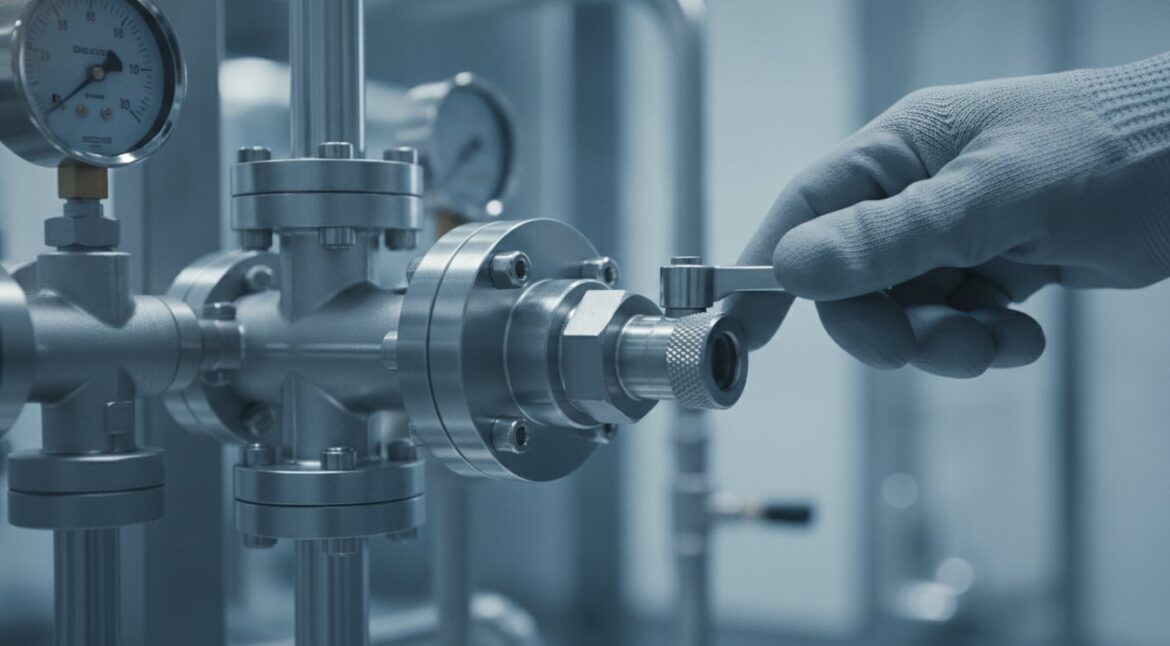
A single component failure in a high-pressure system isn’t just a maintenance delay; it’s a critical safety breach that risks both personnel and infrastructure. You likely recognize that managing trapped pressure is one of the most volatile aspects of system maintenance. Confusion between similar-looking components often leads to unexpected downtime or, worse, dangerous fluid spray-back during routine service. Selecting the correct bleed valve is therefore a matter of fundamental operational integrity rather than a simple hardware choice.
By mastering the technical nuances of these precision-engineered barriers, you’ll ensure safety and precision in even the most demanding high-pressure fluid systems. This guide provides the authoritative insight required to distinguish between venting types and understand material compatibility for corrosive environments. We’ll examine essential design principles, material selection for resilience, and the specific criteria necessary to maintain OSHA-compliant procedures. This systematic overview ensures your facility remains a stable and reliable anchor in a complex industrial landscape.
Key Takeaways
- Understand how a bleed valve functions as a manual safety barrier for venting trapped pressure in instrumentation manifolds and gauge installations.
- Identify the mechanical advantages of needle-and-seat architecture for ensuring leak-proof performance in high-pressure fluid systems.
- Differentiate between bleed, purge, and relief valves to avoid common selection errors that lead to operational downtime.
- Evaluate critical selection factors such as Maximum Allowable Working Pressure (MAWP) and material resilience for extreme temperature environments.
- Implement precise installation and maintenance protocols to ensure safety compliance and protect personnel from hazardous fluid spray-back.
Understanding the Bleed Valve: Definition and Core Functions
A bleed valve is a precision-engineered manual device designed for the controlled venting of trapped fluid or gas from a pressurized system. Unlike general-purpose isolation valves, its primary objective is the safe release of residual pressure to facilitate maintenance, instrument replacement, or system calibration. In high-stakes industrial environments, these components are frequently integrated into a block and bleed manifold, where they provide a secondary safety barrier between the process line and the atmosphere.
Trapped pressure represents a significant safety hazard. It is essentially stored energy that can lead to catastrophic fluid spray-back or sudden mechanical failure if released without control. Engineers utilize the bleed valve to depressurize signal lines or gauge ports before disconnecting hardware. This procedure is essential for protecting personnel from hazardous media and preventing damage to sensitive equipment. Common applications include system depressurization for maintenance, removing air from liquid lines, and creating a safe environment for instrument calibration.
The Critical Role in Instrumentation Systems
Precision is the cornerstone of effective instrumentation. A bleed valve allows technicians to isolate a pressure gauge or transmitter from the main process line and vent the internal cavity. This action enables the safe removal of instruments without requiring a complete process shutdown. It also ensures accurate zero-point calibration. By venting the line to the atmosphere, technicians can confirm that the instrument reads zero before returning it to service. Furthermore, these valves are used to purge air bubbles from liquid-filled lines; this prevents signal damping that could lead to inaccuracies in process data.
Bleed Valve vs. Standard Needle Valves
While they share a similar exterior profile, a bleed valve and a standard needle valve serve distinct operational roles. The most significant structural difference is the presence of a dedicated vent port or bleed hole on the valve body. In a standard needle valve, the fluid enters and exits through threaded connections designed for process flow. In a bleed valve, the fluid is directed out of a small vent hole, typically located on the side of the stem or the body itself.
Flow characteristics also differ significantly. Standard needle valves are designed for fine flow regulation and continuous service. In contrast, bleed valves are not intended for high-flow regulation or continuous operation. They are specialized tools for intermittent venting. Modern manifold systems offer both integrated designs, where the bleed mechanism is built into a single block, and standalone units that provide flexibility for specialized piping configurations. Choosing between these depends on the specific space constraints and safety protocols of the installation.
The Mechanics of Pressure Release: How Bleed Valves Operate
The operational efficiency of a bleed valve relies on a needle-and-seat architecture. This design utilizes a precision-machined stem with a tapered tip that fits into a matching seat within the valve body. When the operator rotates the handle, the stem moves axially to create or break the seal. This metal-to-metal contact ensures a leak-proof shutoff, which is vital in high-pressure fluid systems. Unlike standard instrumentation valves, the bleed variant includes a dedicated vent path. Fluid escapes through a small hole in the stem or a port in the valve body once the seal is cracked.
Safety is integrated into the physical design through a back-seated stem. This feature prevents the stem from being accidentally unscrewed and ejected from the valve body under pressure. It acts as a secondary seal when the valve is fully open. Operators rely on the tactile feedback provided by the operating torque. A firm, consistent resistance indicates a secure seal, while any irregularity in torque can signal debris or seat damage. For those sourcing high-performance components, selecting a manifold valve with integrated bleed functionality provides a streamlined solution for complex instrumentation setups.
Internal Design Features for High-Pressure Safety
High-pressure environments demand specific design considerations to prevent galling and wear. Non-rotating stem tips are a critical feature. These allow the stem to move vertically without spinning against the seat, which significantly extends the service life of the component. Engineers must also choose between metal-to-metal seals for extreme temperatures and soft-seated options for bubble-tight shutoff at lower temperatures. A robust bonnet nut is essential to provide structural integrity and prevent stem blowout, ensuring the valve remains intact even during high-pressure venting cycles. It’s a fundamental requirement for maintaining system resilience.
Manual vs. Automatic Bleeding Mechanisms
Industrial plants predominantly utilize manual bleeding mechanisms for controlled, technician-led venting. This manual control is necessary for precise calibration and maintenance tasks where safety is paramount. In contrast, automatic air release valves (ARVs) are typically found in low-pressure utility lines to continuously remove air pockets without human intervention. When specifying a manual bleed valve, the choice of actuator is important. A T-handle offers greater leverage for high-pressure applications, while a knurled adjustment screw is preferred for compact spaces where finger-tight operation is sufficient. These choices reflect the diverse requirements of modern engineering sectors.
Bleed vs. Purge vs. Relief Valves: Key Differences for Instrumentation
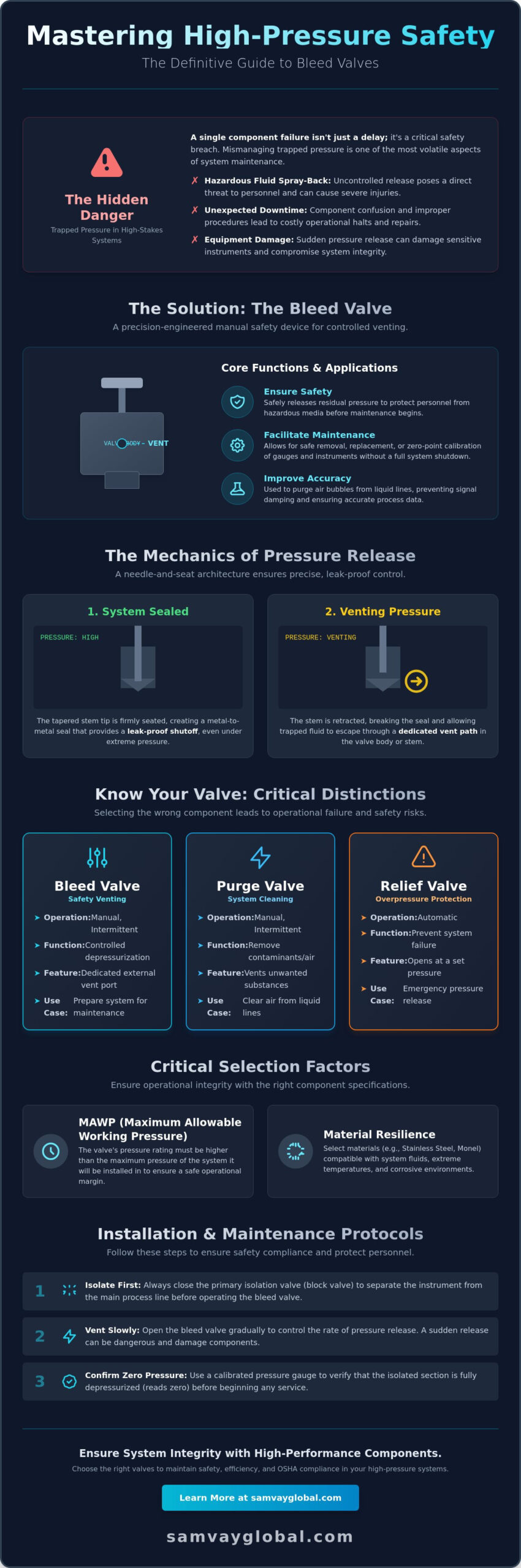
While they may appear similar within a manifold assembly, bleed, purge, and relief valves serve fundamentally different operational purposes. Precision engineering requires that each component be applied strictly according to its design intent. Misidentifying these valves can result in catastrophic system failure, environmental hazards, or the loss of expensive process media. A bleed valve is specifically designed for the manual venting of trapped pressure to the atmosphere, typically during maintenance or calibration. In contrast, purge valves utilize a poppet design to clear systems of air, moisture, or other contaminants. Finally, relief valves act as automatic, spring-loaded safety devices that provide overpressure protection by opening at a predetermined set-point to prevent vessel rupture or piping failure.
Confusing these three components is a common source of industrial accidents. For instance, using a purge valve in a high-pressure venting scenario might result in insufficient flow capacity, while attempting to use a manual bleed valve as a safety relief device leaves the system vulnerable to pressure spikes. Professional engineers must prioritize the specific mechanical architecture of each valve to maintain the long-term integrity of their fluid systems.
Functional Comparison Framework
The specific intent of a bleed valve is to provide a manual vent for trapped pressure, whereas a relief valve is intended for automatic, emergency overpressure protection. One of the most critical distinctions lies in set-point requirements. Relief valves are calibrated to open at a specific pressure limit; bleed valves do not have set-points and rely entirely on operator intervention. Additionally, the direction of discharge varies. A bleed valve almost exclusively vents to the atmosphere. Relief and purge valves, however, are frequently plumbed to return lines, flare systems, or containment vessels to manage hazardous media safely.
Selection Scenarios: Which Valve When?
Choosing the correct component depends on the specific operational objective of the system. Consider these three common industrial scenarios:
- Scenario 1: Zeroing a differential pressure transmitter. In this case, a bleed valve is the correct choice. It allows the technician to vent the manifold to the atmosphere to ensure the instrument reads zero before returning to process flow.
- Scenario 2: Protecting a storage tank from rupture. This requires a relief valve. The valve must automatically actuate if the internal pressure exceeds the tank’s Maximum Allowable Working Pressure (MAWP).
- Scenario 3: Removing moisture from a gas line. A purge valve is utilized here. Its poppet design is ideal for clearing small amounts of liquid or air contaminants to ensure gas purity.
By applying this systematic approach, you ensure that each valve performs its role with reliability and resilience. This methodical selection process is what defines a stable and well-engineered industrial environment.
Selection Criteria for High-Pressure Industrial Bleed Valves
Selecting a bleed valve requires a rigorous evaluation of the operating environment to ensure long-term resilience. The primary consideration is aligning the valve’s pressure rating with the system’s Maximum Allowable Working Pressure (MAWP). For 2026 projects, ASME B16.34 remains the definitive gold standard for determining these pressure-temperature ratings. Temperature extremes pose a significant risk to seal integrity; as heat increases, the mechanical strength of materials can diminish, which potentially leads to seat leakage or stem binding in critical moments. Professional engineers must account for these fluctuations during the initial design phase to prevent premature component failure.
End connections must also be selected based on local piping standards and the required level of leak-tight integrity. Common options include NPT (National Pipe Thread), BSPP (British Standard Parallel Pipe), and specialized compression tube fittings. Each choice impacts the ease of installation and the overall reliability of the connection point. For systems handling corrosive media such as sour gas, chlorides, or aggressive acids, standard 316 stainless steel often proves insufficient. In these high-stakes applications, specifying superior alloys is a prerequisite for operational safety and environmental protection.
Exotic Alloys for Hostile Environments
While many general suppliers limit their range to standard stainless steel, specialized industrial applications require more resilient materials to handle specialized challenges. Duplex and Super Duplex alloys provide exceptional strength and pitting resistance, making them the preferred choice for offshore platforms and marine environments. For processes involving hydrofluoric acid or high-temperature oxidation, Monel and Inconel components offer the necessary chemical stability. In the most aggressive chemical processing plants, Hastelloy serves as the gold standard for resisting localized corrosion and stress corrosion cracking. You can explore our comprehensive range of Nickel Alloy instrumentation tube fittings to find the ideal material for your most demanding high-pressure environments.
Understanding Industry Standards (ASME & ASTM)
Compliance with established engineering codes ensures that every component meets a baseline of safety and performance. ASME B31.3 governs process piping systems and dictates the design requirements for valves used in these networks. Material certification is equally vital; full traceability ensures that the alloy composition matches the design specifications of the project. Finally, rigorous pressure testing protocols verify the valve’s performance before deployment. In 2026, API 598 remains the most widely recognized standard for valve inspection and testing, covering both hydrostatic and pneumatic procedures to ensure a leak-proof seal under full operating pressure. This methodical approach to verification is essential for maintaining a stable and principled industrial infrastructure.
Best Practices for Installation and System Maintenance
The long-term reliability of a bleed valve is determined as much by its field installation as by its internal metallurgy. Precision during the setup phase prevents the very failures that these components are designed to mitigate. When installing the valve, the technician must ensure the vent port is oriented away from all personnel walkways and control stations. This simple directional choice is a fundamental safety barrier that protects operators from accidental fluid discharge during venting cycles. It’s an essential protocol that distinguishes professional-grade installations from standard utility setups.
Thread sealant application requires a methodical approach to prevent system contamination. Technicians should apply PTFE tape or anaerobic sealants starting two threads back from the end of the fitting. This prevents fragments of sealant from entering the fluid path and clogging the delicate needle-and-seat interface. Adhering to specific torque requirements is equally vital. Over-tightening can deform the metal-to-metal seat; this compromises the valve’s ability to achieve a bubble-tight shutoff. In stagnant process lines, regular “cycling” of the valve stem prevents sticking and ensures the component is ready for immediate operation during maintenance windows.
Safety Protocols for High-Pressure Venting
Safety is a non-negotiable priority in high-pressure environments. Mandatory PPE, including impact-resistant safety goggles and chemical-resistant gloves, must be worn during all bleed operations. Even a small amount of residual pressure can cause high-velocity spray-back that poses a risk of skin penetration or eye injury. Technicians should always employ the “Slow Vent” technique. By cracking the valve open gradually, you prevent the rapid expansion of gases and the damaging effects of “water hammer” within the instrumentation manifold.
For systems involving hazardous or environmentally sensitive media, capturing the discharge is a requirement. Using small-diameter tubing to route the vented fluid from the port to a safe containment area or recovery vessel prevents localized contamination. This practice ensures that your facility remains compliant with increasingly stringent environmental regulations while maintaining a clean and professional workspace.
Samvay Fluid Tekniks Inc: Precision Engineering for Global Industry
Samvay Fluid Tekniks Inc serves as a steadfast guide for organizations requiring high-performance fluid control solutions. We specialize in integrating advanced bleed functionality into custom Manifold Valve designs, ensuring that every connection point is a reliable anchor for your infrastructure. Our commitment to quality is reflected in our use of resilient materials, including Titanium and various Nickel Alloy instrumentation tube fittings, which provide the durability needed for the world’s most demanding industrial landscapes. We invite you to consult with a Samvay engineer for your high-pressure valve requirements to ensure your systems operate with unwavering precision and safety.
Securing System Integrity Through Precision Engineering
Mastering the technical nuances of the bleed valve is a fundamental requirement for any professional managing high-pressure fluid systems. We’ve examined how the correct mechanical architecture and deliberate material selection prevent catastrophic spray-back while ensuring accurate instrument calibration. By adhering to rigorous installation standards and selecting alloys suited for corrosive environments, you protect both your personnel and your long-term infrastructure investments. This systematic approach to component selection is what defines a stable and well-engineered industrial environment.
Samvay Fluid Tekniks Inc remains a dedicated partner in this journey, providing authoritative expertise in high-pressure fluid control since our inception. We specialize in precision-engineered Duplex Steel, Nickel Alloy, and Titanium components designed for the most demanding global industrial sectors. These resilient solutions ensure your operations remain a reliable anchor in a challenging landscape. Explore Samvay’s High-Pressure Instrumentation Valves to enhance your system’s safety and performance. We look forward to supporting your commitment to industrial excellence and technical precision.
Frequently Asked Questions
What is the primary difference between a bleed valve and a purge valve?
The primary difference lies in their mechanical design and intended function. A bleed valve is a manual device designed to vent trapped pressure or fluid directly to the atmosphere. A purge valve utilizes a poppet-style mechanism to clear systems of air or moisture. While both assist in system maintenance, the bleed variant is specifically engineered for depressurization rather than contaminant removal.
Can a bleed valve be used for continuous flow control?
No, you shouldn’t use a bleed valve for continuous flow control or regulation. These components are designed for intermittent venting and depressurization tasks. Using them for continuous throttling can lead to seat erosion and premature failure of the needle tip. For precise flow regulation in high-pressure lines, a dedicated needle valve is the appropriate engineering choice.
What materials are best for bleed valves in sour gas (H2S) service?
Sour gas service requires materials that comply with NACE MR0175/ISO 15156 standards to prevent sulfide stress cracking. Specialized alloys such as Monel, Inconel, and Hastelloy provide the necessary resilience for these aggressive environments. These high-performance materials ensure the valve maintains its structural integrity when exposed to hydrogen sulfide and other corrosive agents.
How do I know if a bleed valve is fully closed?
You can confirm a bleed valve is closed through tactile feedback and the cessation of fluid discharge. As the stem reaches the seat, you’ll feel a firm, consistent resistance. Once fully seated, no fluid or gas should escape from the vent port. If discharge continues despite reaching the closed position, the internal seat may be contaminated or damaged.
Are bleed valves required by law in high-pressure systems?
While specific laws vary by jurisdiction, safety regulations such as OSHA’s Lockout/Tagout (LOTO) standards effectively mandate the use of pressure-venting devices. These standards require the safe release of stored energy before maintenance begins. A bleed valve provides the necessary mechanism to comply with these safety protocols and ensure a zero-energy state in pressurized instrumentation lines.
What is the maximum pressure rating typically available for instrumentation bleed valves?
Standard industrial bleed valves are typically rated for pressures up to 10,000 PSI (689 bar). The specific rating depends on the material of construction and the operating temperature. You must always verify that the valve’s pressure rating aligns with your system’s Maximum Allowable Working Pressure (MAWP) as defined by ASME B16.34.
How often should industrial bleed valves be inspected for wear?
Inspection frequency depends on the severity of the service and the nature of the media. In standard process environments, you should inspect bleed valves annually or during scheduled system shutdowns. More frequent checks are necessary for systems handling abrasive or corrosive fluids, where seat wear and stem galling are more likely to occur.
Can I replace a bleed valve without shutting down the entire system?
You can only replace a bleed valve without a full system shutdown if the component is properly isolated. In a manifold configuration, closing the primary block valve allows you to vent the cavity and safely remove the bleed component. Without a dedicated isolation point, you must depressurize the entire process line to prevent hazardous fluid release.