
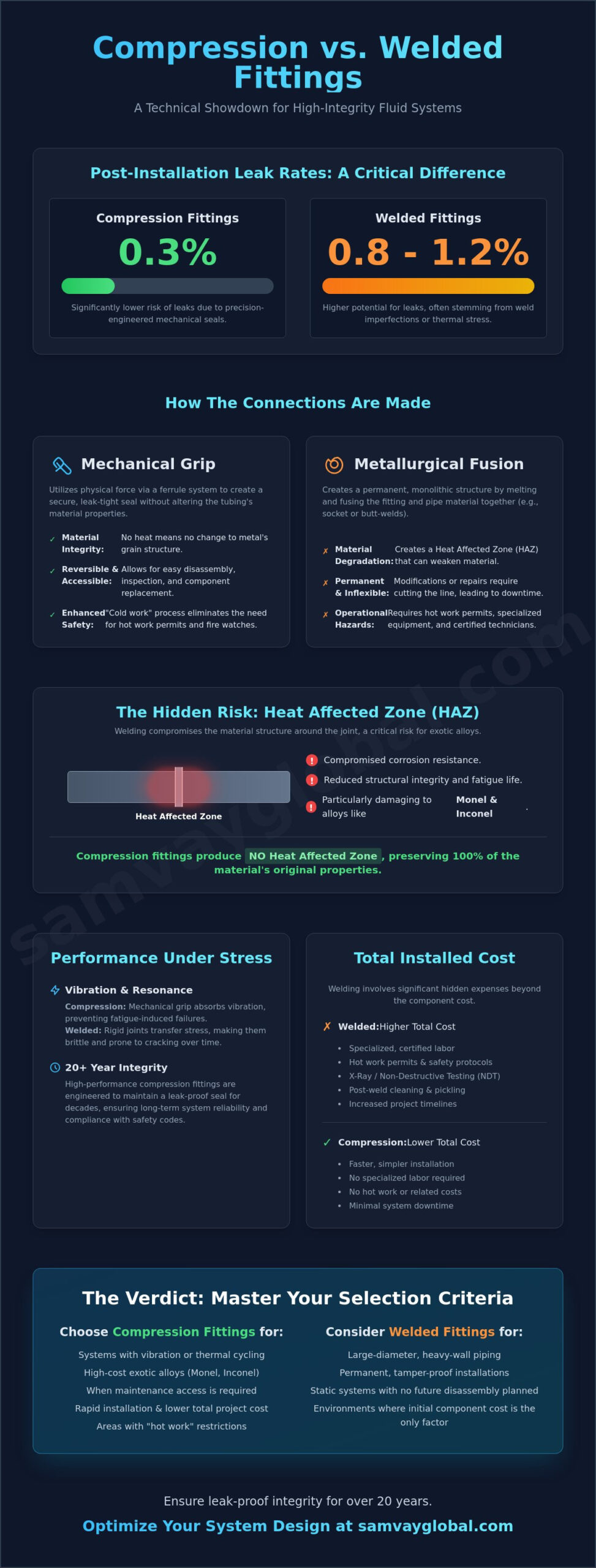
Did you know that post-installation leak rates for mechanical connections can be as low as 0.3 percent, while welded alternatives often range between 0.8 and 1.2 percent? This statistic challenges the traditional assumption that metallurgical fusion is the only reliable path to a permanent seal. When evaluating compression fittings vs welded fittings, engineers must look beyond the initial joint to consider the long-term integrity of the entire system. We recognize that system leakage and the high cost of specialized labor for exotic alloys are significant hurdles in modern plant design.
This guide provides a technical framework to master the trade-offs between mechanical compression and metallurgical fusion, ensuring your high-pressure connections remain leak-proof for over 20 years. We’ll analyze how to optimize your installation budget while maintaining strict compliance with industrial safety codes. Our technical breakdown covers material performance and installation economics to help you address current market challenges, including the structural scarcity of high-performance components. You’ll gain the insights needed to select the most resilient connection for your specific industrial environment.
Key Takeaways
- Distinguish between the mechanical grip of ferrule-based seals and the permanent metallurgical fusion of socket or butt-weld techniques to determine the best fit for your system architecture.
- Identify the risks associated with the Heat Affected Zone (HAZ), particularly how welding can compromise the corrosion resistance and structural integrity of exotic alloys like Monel or Inconel.
- Compare the total installed cost of compression fittings vs welded fittings by accounting for hidden expenses such as X-ray inspections, specialized labor, and post-weld cleaning.
- Analyze how mechanical compression handles system resonance and vibration compared to rigid welded joints to prevent fatigue-induced failures in high-pressure environments.
- Master the selection criteria for high-performance instrumentation tube fittings to ensure leak-proof integrity for over 20 years while maintaining compliance with industrial safety codes.
Mechanical vs Metallurgical: The Core Connection Mechanisms
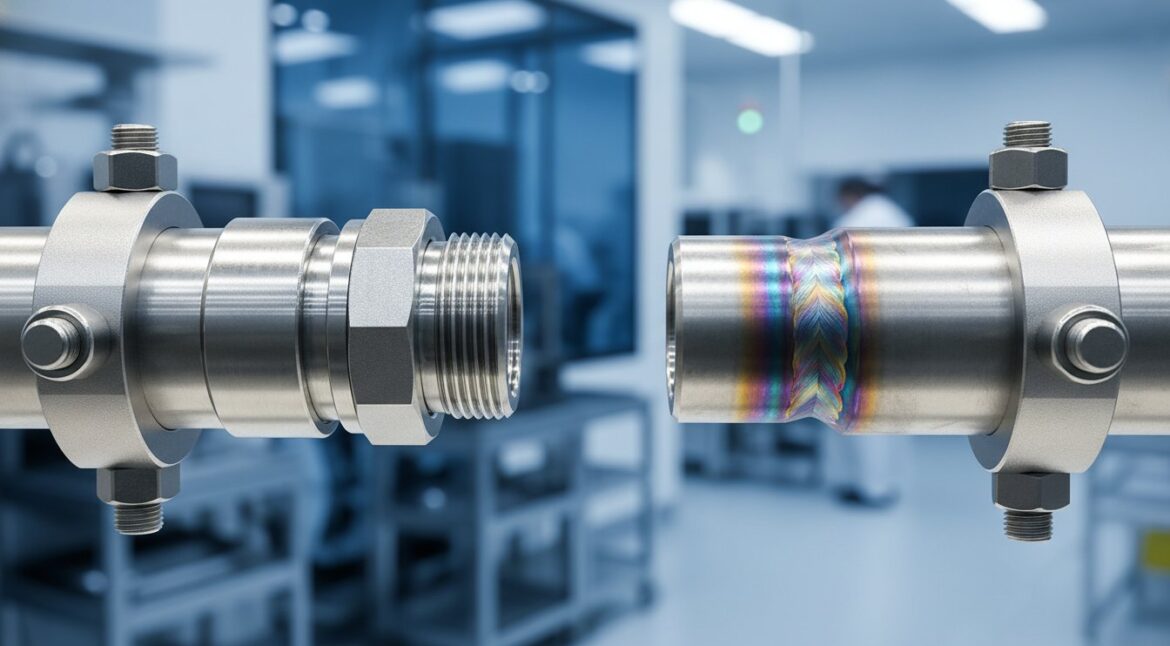
The fundamental decision in fluid system design rests on the method of joining components. When comparing compression fittings vs welded fittings, engineers must evaluate the structural transition between the fitting body and the conduit. A mechanical connection relies on physical force to deform a secondary component, usually a ferrule, against the tubing. Conversely, a metallurgical connection creates a unified structure by melting the interface between the fitting and the pipe. This choice doesn’t just influence the initial assembly; it also dictates the system’s ability to withstand operational stresses and long-term maintenance requirements.
An Instrumentation Tube Fitting typically employs a mechanical approach to maintain leak-tight integrity without compromising the tubing material’s state. This is critical in high-pressure environments where material thinning or heat-induced crystallization could lead to premature failure. For specialized pneumatic applications where flexible conduits are required, manufacturers like Abbey Extrusions provide high-performance hoses that integrate seamlessly with these mechanical systems. In contrast, a High Pressure Pipe Fitting used in welding applications provides a permanent, tamper-proof seal. This is often preferred for large-diameter, heavy-wall piping where future disassembly isn’t required and the system stays static for its entire lifecycle.
How Compression Fittings Create a Seal
The efficiency of a mechanical seal depends on the precision of the ferrule system. In a high-performance dual-ferrule design, the assembly works through a coordinated movement of parts. The front ferrule creates a pressure-tight seal against the fitting body and the tubing surface. Simultaneously, the back ferrule provides the necessary grip to hold the tubing securely. Mechanical grip is a cold-work process that avoids thermal stress. Because there’s no heat involved, the tubing wall thickness and its original corrosion-resistant properties remain intact. This Compression fitting technology allows for repeated assembly and disassembly. It offers a level of system flexibility that welding can’t match. Key benefits of this mechanism include:
- Material Integrity: No alteration of the metal’s grain structure occurs during installation.
- Ease of Access: Components can be replaced or inspected without cutting the line.
- Safety: Installation requires no flame or specialized “hot work” permits.
The Permanent Nature of Welded Connections
Welded connections are defined by their permanence and structural continuity. Socket welds are frequently utilized for smaller pipe sizes. In this method, the pipe is inserted into a recessed area of the fitting before a fillet weld is applied. Butt-welds are preferred for larger, high-pressure systems. These require the ends of the pipe and fitting to be beveled and fused together to create a continuous flow path. These processes demand strict adherence to standards like ASME Section IX, requiring certified technicians to perform the work. Beyond technical skill, welding presents operational challenges in “hot work” restricted zones, such as active chemical plants or offshore platforms. The need for specialized equipment and safety protocols often extends project timelines compared to the rapid installation of mechanical alternatives.
Performance Metrics: Pressure, Vibration, and Leakage Resistance
Selecting between compression fittings vs welded fittings demands a rigorous evaluation of how a connection behaves under dynamic load. While static pressure ratings are fundamental, real-world industrial environments introduce vibration, thermal cycling, and potential leak paths that challenge system integrity. Engineers shouldn’t view these as mere components but as critical nodes in a high-stakes fluid network. Reliability in these environments is measured by a system’s ability to maintain a seal for decades, not just during the initial pressure test.
The 2026 baseline for high-pressure water transmission and urban fire safety infrastructure is now 2.5 MPa (363 psi). Both connection types can meet this standard, yet they handle the stress differently. A welded joint creates a rigid, monolithic structure that is exceptionally strong but unforgiving. Data from recent industry assessments indicates that mechanical systems achieve lower post-installation leak rates, sitting at approximately 0.3 percent compared to the 0.8 to 1.2 percent often found in welded systems. This difference often stems from weld porosity or micro-cracking that occurs during the cooling phase.
Pressure Handling in Instrumentation Systems
In most instrumentation loops, the tubing wall thickness is the weakest link. The fitting is engineered to be stronger than the conduit it connects. If a system fails under extreme PSI, the tube should burst before the fitting leaks or blows off. This safety margin is vital for protecting sensitive equipment. Our range of high-pressure instrumentation tube fittings is tested to ensure they maintain a gas-tight seal even when the tubing reaches its plastic deformation limit. It’s a level of precision that ensures the connection remains the most reliable part of the loop.
Vibration and Fatigue Management
Vibration is a silent killer in industrial piping. Rigid welded joints are prone to fatigue failure at the transition point near the weld bead. This area often harbors residual stresses from the fusion process. Mechanical compression fittings provide a degree of dampening that rigid joints lack. The ferrule’s grip acts as a buffer, absorbing some of the harmonic energy that would otherwise stress the metal. Proper tube support remains essential regardless of the connection type. Standard vibration testing, such as those defined in ASTM F1387, confirms that a well-designed mechanical grip can outperform a rigid weld in high-resonance environments. This resilience makes compression systems a preferred choice for reciprocating compressors and high-flow steam lines where constant oscillation is expected.
Metallurgical Integrity: The Impact on Exotic Alloys
Engineering a high-pressure system requires more than just calculating burst pressures. It demands an understanding of how connection methods alter the base metal’s molecular structure. In the debate of compression fittings vs welded fittings, the most critical factor for exotic alloys is the Heat Affected Zone (HAZ). This is the area of base metal that hasn’t melted but has had its microstructure and properties changed by the intense heat of welding. For high-performance materials like Monel or Inconel, these thermal shifts can compromise the very characteristics that justified the material’s selection in the first place.
Mechanical connections avoid these thermal risks entirely. By using a “cold” installation process, an Instrumentation Tube Fitting maintains the tubing’s original grain structure. This is especially vital when working with reactive metals like Titanium or high-strength alloys like Duplex Steel. When you bypass the welding process, you eliminate the need for Post-Weld Heat Treatment (PWHT), a complex and costly procedure often required to relieve residual stresses and restore material properties after fusion.
Corrosion Risks in Welded Joints
Intergranular corrosion remains a primary threat to welded stainless steel and nickel alloy systems. During the welding process, temperatures between 425 and 870 degrees Celsius cause chromium and carbon to react, forming chromium carbides at the grain boundaries. This “sensitization” leaves the surrounding areas depleted of chromium, which is the element responsible for the metal’s protective oxide layer. Once this layer is compromised, the joint becomes susceptible to rapid localized decay, often referred to as weld decay. Compression fittings preserve the pre-engineered corrosion resistance of the tubing by eliminating the thermal cycles that trigger carbide precipitation. This ensures that the system maintains its integrity in aggressive chemical environments without requiring expensive low-carbon “L-grade” alloys or complex stabilizing heat treatments.
Specialized Material Considerations
The challenge intensifies when working with Duplex Steel. This material relies on a precise 50/50 balance between austenite and ferrite phases to provide both strength and chloride resistance. The rapid heating and cooling of a weld can easily skew this ratio, leading to embrittlement or stress corrosion cracking. Similarly, alloys like Hastelloy are sensitive to thermal stress, which can lead to hot cracking during the solidification of the weld bead. Utilizing a Monel Instrumentation Tube Fitting or a Hastelloy Instrumentation Tube Fitting ensures a material match that respects these metallurgical boundaries. By choosing a mechanical grip, you ensure the fitting and the tubing work as a cohesive unit, maintaining the specific alloy chemistry required for your application’s success.
- Nickel Alloy Instrumentation Tube Fitting: Ideal for high-temperature, high-pressure environments where thermal stress must be avoided.
- Titanium Instrumentation Tube Fitting: Provides excellent strength-to-weight ratios without the risk of atmospheric contamination during joining.
- Duplex Steel Instrumentation Tube Fitting: Maintains the critical phase balance necessary for offshore and subsea applications.
Operational Trade-offs: Installation and Lifecycle Costs
The financial viability of a high-pressure system depends on its Total Installed Cost (TIC) rather than the price of individual components. While mechanical fittings often carry a higher initial purchase price, they frequently deliver a lower TIC due to reduced labor and inspection requirements. When evaluating compression fittings vs welded fittings, the speed of assembly remains the most visible differentiator. A mechanical connection is typically completed in minutes using standard hand tools, whereas a welded joint requires hours of preparation, execution, and mandatory cooling periods. These time savings are critical in large-scale projects where thousands of connections are required.
Beyond the clock, hidden costs often inflate the budget for welded systems. Non-destructive testing (NDT), such as X-ray or ultrasonic inspections, is a mandatory expense to ensure joint integrity in critical lines. You must also account for the intensive cleaning and flushing required to remove slag or internal oxidation that could damage sensitive downstream components like a Ball Valve or Check Valve. Maintenance access provides another significant operational advantage. Compression fittings offer “break-and-remake” capability, allowing for rapid system modifications or component replacement without the need for hot work permits or specialized equipment. This flexibility is essential in volatile environments where downtime must be minimized to maintain profitability.
Cost Analysis: Initial vs. Total Ownership
Labor represents the largest variable in system installation. Verified industry data from June 2026 indicates that mechanical fittings can reduce installation labor by 50 to 70 percent compared to traditional welding. This shift addresses the current shortage of certified welders capable of working with exotic alloys. Additionally, maintenance downtime can be reduced by as much as 80 percent when using mechanical alternatives. Eliminating the need for specialized welding gases, heavy power sources, and fire watches further optimizes the project budget. For those managing complex instrumentation loops, specifying precision-engineered instrumentation tube fittings can result in a 12 to 18 percent saving in total installed cost over the system’s lifecycle.
The 5-Step Selection Framework
To ensure system integrity and economic efficiency, we recommend this structured selection process:
- Assess the fluid type: Determine if the media is hazardous, toxic, or inert to establish the required seal reliability.
- Evaluate the pressure and temperature profile: Confirm that the fitting rating exceeds the maximum potential system surge.
- Determine maintenance frequency: Choose mechanical connections for areas requiring regular inspection or component replacement.
- Verify local safety codes: Ensure the connection method complies with specific regional insurance and industrial standards.
- Select the material grade: Match the fitting alloy to the tubing to prevent galvanic corrosion in aggressive environments.
Selecting High-Performance Fittings for Critical Systems
The technical debate between compression fittings vs welded fittings ultimately converges on the requirement for precision. While general piping systems may tolerate standard industrial variances, high-pressure instrumentation loops demand much tighter tolerances to ensure long-term stability. A microscopic misalignment or a minor metallurgical defect can compromise a system that’s expected to operate for over 20 years. Selecting the right connection isn’t just about the joint itself; it’s about the reliability of the manufacturer and the consistency of the raw materials used in production.
Sourcing your fluid control components from a single, specialized manufacturer provides a significant advantage in system compatibility. When a Ball Valve, Check Valve, and Manifold Valve are engineered to the same exacting standards as the fittings, the risk of interface failure is virtually eliminated. This integrated approach ensures that every component in the high-pressure loop responds uniformly to thermal expansion and system vibration. In an era where structural scarcity has pushed lead times for specialized components to 16 to 24 weeks, having a reliable partner with robust global supply capabilities is essential for maintaining project timelines and operational safety.
Samvay Fluid Tekniks Inc Precision Engineering Standards
Our manufacturing process is centered on the use of high-performance alloys designed for the most demanding environments. Samvay Fluid Tekniks Inc provides specialized solutions including a Monel Instrumentation Tube Fitting, a Hastelloy Instrumentation Tube Fitting, and a Titanium Instrumentation Tube Fitting. Each component undergoes rigorous quality control protocols to verify dimensional accuracy and material integrity. This is particularly important for 2.5 MPa rated systems, which have become the baseline standard for high-rise infrastructure and high-pressure water transmission. While these systems ensure delivery, you can check out ITAMILANO to learn how the resulting water quality affects personal wellness. By maintaining strict adherence to international standards and providing full traceability, we ensure that our products meet the green-certified and Environmental Product Declaration (EPD) requirements that are increasingly mandatory for global market access.
Moving Forward with Samvay Fluid Tekniks Inc
Choosing the correct connection method requires a deep understanding of both mechanical principles and metallurgical science. The team at Samvay Fluid Tekniks Inc acts as a steadfast guide, helping engineers navigate the complexities of material selection and connection architecture. Whether you’re dealing with the challenges of weld-induced corrosion in exotic alloys or looking to optimize your total installed cost, we provide the technical expertise to secure your system. We invite you to explore our comprehensive Instrumentation Tube Fitting range to find the precision-engineered solutions your next project requires. Let’s work together to build a resilient and leak-proof industrial landscape that stands the test of time.
Securing System Integrity in Future Industrial Landscapes
The decision-making process for high-pressure connections has evolved beyond simple permanence. Modern engineers now prioritize material longevity and operational agility to combat system downtime and skilled labor shortages. By evaluating the technical nuances of compression fittings vs welded fittings, you ensure that your system architecture remains resilient against vibration and corrosion. We’ve established that mechanical compression preserves the metallurgical properties of high-performance alloys while significantly reducing installation time and inspection overhead.
As a specialized manufacturer of Duplex Steel and Nickel Alloy fittings, we understand the high stakes of industrial fluid control. Our components are precision-engineered for demanding environments, serving as a reliable anchor for the global oil, gas, and chemical sectors. We’re committed to providing the technical precision required for your most specialized challenges. We invite you to Request a Technical Quote for Samvay High-Pressure Fittings to see how our expertise can stabilize your critical infrastructure. Choosing the right partner today guarantees a leak-proof and compliant system for decades to come.
Frequently Asked Questions
Can compression fittings be used for high-pressure gas applications?
Yes, instrumentation-grade compression fittings are specifically engineered for high-pressure gas service. They provide a gas-tight seal through the controlled deformation of ferrules against the tubing. This mechanical grip ensures that the connection remains secure even with small-molecule gases like helium or hydrogen. It’s essential to use high-quality tubing with a surface finish free of scratches to prevent potential leak paths.
Are welded fittings always more reliable than compression fittings?
No, welded fittings aren’t inherently more reliable in every scenario. While they offer a permanent metallurgical bond, they’re susceptible to weld porosity and fatigue at the heat-affected zone. As noted previously, post-installation leak rates for compression fittings vs welded fittings show that mechanical connections often achieve higher initial success rates. Reliability is ultimately a function of proper installation and material compatibility rather than the joining method alone.
Do compression fittings require periodic tightening?
Properly installed compression fittings don’t require periodic tightening. In fact, retightening a fitting that isn’t leaking can actually cause damage by over-stressing the ferrules or the fitting body. If a leak occurs, it’s usually a sign of incorrect initial installation or damaged tubing. Maintenance should focus on visual inspections and ensuring that the system supports are preventing excessive mechanical strain on the joints.
What are the main advantages of using socket weld fittings over butt-weld?
Socket weld fittings provide easier alignment during assembly compared to butt-weld alternatives. They don’t require the pipe ends to be beveled, which simplifies the preparation process for smaller diameter lines. This design also prevents weld spatter from entering the flow path, making them a practical choice for systems where internal cleanliness is a priority. However, they do create a small gap where corrosive media can potentially collect.
How do I know if my compression fitting is installed correctly?
You can verify a correct installation by using a gap inspection gauge after the initial pull-up. This tool ensures the nut has been tightened the required number of turns from the finger-tight position. For most instrumentation tube fittings, this is typically one-and-one-quarter turns. If the gauge cannot fit between the nut and the fitting body, the connection has been sufficiently tightened to ensure a leak-proof seal.
Can I reuse a compression fitting after taking it apart?
You can disconnect and remake a compression fitting multiple times without compromising its integrity. While the ferrules become permanently swaged onto the tubing during the first installation, the fitting body and nut remain reusable. It’s critical to ensure the ferrules seat back into their original position during reassembly. You should only tighten the nut slightly past the previous position to restore the original seal.
Why is welding exotic alloys like Hastelloy more difficult than stainless steel?
Welding exotic alloys like Hastelloy is challenging because these materials are highly sensitive to thermal stress and atmospheric contamination. They have a higher risk of hot cracking during the cooling phase compared to standard stainless steels. Maintaining the specific alloy chemistry across the weld bead requires precise control of heat input and shielding gases. This complexity is why many engineers prefer mechanical connections to preserve the material’s pre-engineered corrosion resistance.
Which connection type is better for high-vibration environments?
Compression fittings are generally superior for high-vibration environments because they offer inherent dampening. A rigid welded joint is a monolithic structure that concentrates stress at the transition point, often leading to fatigue failure. The mechanical grip of a dual-ferrule fitting allows the connection to absorb harmonic energy more effectively. This resilience makes them the preferred choice for reciprocating equipment and high-flow steam applications where constant oscillation is present.