
Defining Excellence in Ball Valve Manufacturing
In the world of industrial fluid control, selecting a component supplier is a critical decision. When the component in question is a Ball valve, a quarter-turn flow control device engineered for reliability, the choice of manufacturer directly impacts system safety, efficiency, and longevity. However, a crucial distinction exists within this category: the difference between large-bore process valves designed for bulk fluid transfer and high-precision instrumentation valves engineered for critical measurement and control loops. For engineers in the oil, gas, and chemical sectors, understanding this distinction is the first step toward building a truly reliable system.
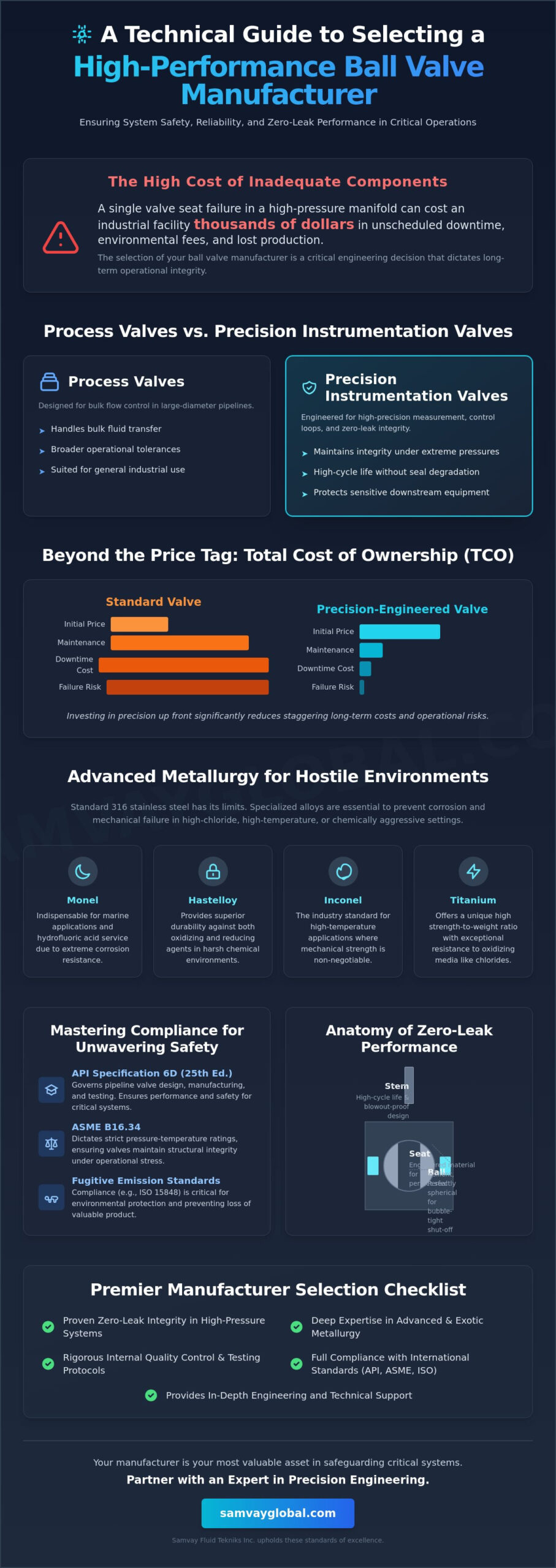
An instrumentation ball valve is not merely a smaller version of a process valve; it is a specialized component designed with different priorities. While a process valve’s primary role is bulk isolation, an instrumentation valve must provide flawless, repeatable shutoff to protect sensitive, high-value equipment. The manufacturer’s technical capability—their mastery of metallurgy, precision machining, and rigorous testing—becomes the primary factor in ensuring system integrity. This shifts the procurement focus from initial purchase price to the Total Cost of Ownership (TCO). A valve that costs slightly more upfront but prevents a single instance of downtime or protects a multi-thousand-dollar transmitter from damage delivers immeasurably greater value over its lifecycle.
The Role of Instrumentation Valves in Critical Systems
Instrumentation valves are the guardians of a plant’s nervous system. They operate in high-pressure environments where even a minuscule leak is unacceptable. Their role is to provide precise isolation for gauges, transmitters, analyzers, and other sensitive instruments, ensuring accurate readings and protecting equipment from pressure surges or corrosive media. Key performance requirements include:
- Zero-Leakage Performance: In high-pressure gas or volatile fluid applications, bubble-tight shutoff is non-negotiable. This protects personnel, prevents fugitive emissions, and ensures the accuracy of analytical measurements by preventing sample contamination.
- High-Cycle Life: Instrumentation valves, particularly those in automated sampling or testing systems, may be actuated thousands of times. A robust design with superior seat and seal materials is essential for long-term, reliable operation without performance degradation.
- Compact Design: These valves are often installed in tight spaces, such as instrument panels, enclosures, or on sampling skids. A compact footprint without compromising pressure ratings or durability is a critical design consideration.
Why Manufacturer Specialization Matters
The market for ball valves is vast, but not every ball valve manufacturer is equipped to produce components for high-stakes instrumentation. The difference lies in specialization. Generic, mass-production facilities are optimized for volume and standard applications, often focusing on cast steel or brass commodity valves. A specialist instrumentation valve manufacturer, however, operates on a foundation of precision engineering. Their processes are designed for tight tolerances, exotic materials, and the rigorous quality control demanded by critical systems.
This specialization extends beyond the factory floor. An expert manufacturer provides invaluable engineering support, helping clients select the optimal materials and valve configurations for challenging applications. They understand the nuances of global compliance standards like ISO 9001:2015 for quality management and ASME for design integrity, ensuring their products are suitable for international projects and reducing procurement risk. Choosing a specialist is not just buying a product; it is engaging an engineering partner dedicated to the safety and performance of your system. If you are looking for a specialist supplier for the oil, gas, or petrochemical sectors, click here to learn more about OG VALVES LTD.
Advanced Metallurgy: Selecting the Right Valve Material
While 316 stainless steel is a versatile and common choice for many industrial applications, its limitations become apparent in the face of highly corrosive media, extreme temperatures, or high chloride concentrations found in offshore and chemical processing environments. For instrumentation systems handling such aggressive fluids, a manufacturer’s expertise in advanced metallurgy is paramount. The integrity of a multi-million-dollar system can depend on the correct specification of a valve material that costs only a fraction of that amount.
Leading manufacturers offer a range of exotic alloys to meet these challenges. Each material provides a unique profile of chemical resistance, strength, and temperature stability:
- Monel: This nickel-copper alloy offers exceptional resistance to hydrofluoric acid, a highly corrosive substance, and performs well in marine and chemical processing applications.
- Hastelloy: A nickel-molybdenum-chromium superalloy, Hastelloy provides outstanding resistance to a wide range of corrosive media, including hydrochloric and sulfuric acids.
- Inconel: Known for its performance in extreme temperature and pressure environments, this nickel-chromium alloy maintains its strength and resists oxidation and corrosion at high temperatures.
- Titanium: With an unmatched strength-to-weight ratio and exceptional resistance to chloride-based corrosion, titanium is ideal for applications involving seawater, chlorine, and other oxidizing chemicals.
- Duplex and Super Duplex Steel: These materials offer a combination of strength and corrosion resistance superior to standard austenitic stainless steels, particularly against chloride stress corrosion cracking.
The choice of material directly dictates the valve’s pressure-temperature ratings and its suitability for a given service. A knowledgeable manufacturer will provide detailed charts and technical support to ensure the selected alloy meets the specific demands of the process fluid and operating conditions.
Corrosion Resistance in Harsh Environments
In sectors like oil and gas, the presence of sour gas (H2S) poses a significant threat to material integrity, leading to sulfide stress cracking and catastrophic failure. Likewise, subsea and offshore platforms demand materials that can withstand constant exposure to corrosive saltwater. A specialist ball valve manufacturer understands these challenges and engineers solutions accordingly. For instance, Duplex steel’s high resistance to pitting corrosion is quantified by its pitting resistance equivalent number (PREN), which is calculated based on its chromium, molybdenum, and nitrogen content to predict its performance in chloride-rich environments. Evaluating a manufacturer’s deep knowledge of material performance in these specific, hostile applications is a crucial step in the selection process.
Material Traceability and Quality Assurance
When specifying an exotic alloy, trust is not enough; verification is essential. A reputable manufacturer must provide complete material traceability for every pressure-containing component. This is accomplished through Material Test Reports (MTRs), also known as Mill Test Certificates, which document the chemical and mechanical properties of the raw material heat lot from which the component was made. This documentation is the engineer’s guarantee that the material specified is the material delivered.
Furthermore, elite manufacturers implement stringent quality controls to prevent material contamination during production. This includes dedicated machining centers for specific alloy groups and robust handling procedures. To provide a final layer of assurance, they employ Positive Material Identification (PMI) testing. This non-destructive testing method uses a portable analyzer to verify the chemical composition of finished components, confirming that the valve body, ball, and stem match the MTR and the purchase order specifications.
Engineering for Zero-Leak Performance
The promise of a ball valve is its ability to provide a positive, leak-tight shutoff. In high-pressure instrumentation, achieving this “zero-leak” standard requires a deep understanding of mechanical engineering, material science, and fluid dynamics. The anatomy of an instrumentation ball valve—the ball, seats, and stem—is a system where each component’s design and manufacturing precision contribute to overall performance. The primary engineering challenge is maintaining seal integrity under high pressure, across a wide temperature range, and over thousands of operational cycles.
This challenge is met through careful design and material selection, particularly for the valve seats. The choice between soft-seated and metal-seated designs is application-dependent:
- Soft-Seated Valves: Using materials like PTFE, PEEK, or other polymers, these valves provide excellent bubble-tight sealing in general service and chemical applications within their temperature limits.
- Metal-Seated Valves: For high-temperature or abrasive service, metal seats (often with specialized hard coatings) provide durability and maintain sealing performance where soft seats would fail.
Another critical factor, especially for automated systems, is the valve’s operating torque. A well-engineered valve provides low, consistent torque, which allows for the use of smaller, more cost-effective actuators and reduces stress on the valve stem and packing, contributing to a longer service life.
Precision Machining and Tolerance Control
The performance of a high-pressure ball valve is forged in microns. The degree of precision achieved during the manufacturing process is what separates a standard component from an instrumentation-grade valve. Key areas of focus include:
- Ball Sphericity: The roundness of the ball is critical. Any deviation from a perfect sphere creates potential leak paths and causes uneven pressure on the seats, leading to premature wear and failure. Top-tier manufacturers use advanced grinding techniques to achieve exceptional sphericity.
- CNC Machining: Modern Computer Numerical Control (CNC) machining is essential for achieving the tight, repeatable tolerances required for valve bodies, stems, and end connections. This ensures perfect alignment and fit-up, which is crucial for seal integrity.
- Surface Finish: The surface finish of the ball and stem has a direct impact on the life of the seats and stem packing. An ultra-smooth, mirror-like finish reduces friction and operational torque, preventing the galling and abrasion that can compromise a seal.
Testing Protocols: Beyond the Standard
A manufacturer’s commitment to quality is ultimately proven in its testing protocols. While industry standards provide a baseline, leading manufacturers often exceed these requirements to guarantee performance. Standard procedures include hydrostatic testing, where the valve is filled with water and pressurized to 1.5 times its working pressure to verify shell integrity, and pneumatic testing, which uses pressurized gas to check for seat leakage. For critical gas service, the significance of helium leak testing cannot be overstated; its small molecular size allows it to penetrate leak paths that other media cannot, making it the definitive test for fugitive emissions and ensuring bubble-tight performance. A core industry standard, API 598 provides comprehensive requirements for the inspection, examination, and pressure testing of valves to ensure they meet specified performance criteria before shipment.
Navigating Industry Standards and Compliance
For an engineer, specifying a component that adheres to recognized international standards is a fundamental aspect of risk management and system design. A competent ball valve manufacturer must not only claim compliance but also demonstrate a deep understanding of these standards and how they apply to specific applications. Navigating this landscape is essential for ensuring safety, interoperability, and regulatory approval.
Key standards governing the design and application of instrumentation ball valves include:
- ASME B16.34: This standard dictates the pressure-temperature ratings, dimensions, and testing requirements for valves, providing a reliable framework for safe valve selection and application.
- API 608 & API 6D: While often associated with larger process valves, the design principles in API 608 for metal ball valves are foundational. Understanding a manufacturer’s adherence to these principles, even for smaller instrumentation valves, provides insight into their design philosophy.
- NACE MR0175/ISO 15156: This is a critical standard for the oil and gas industry, providing material requirements for components used in H2S-containing (sour gas) environments to prevent sulfide stress cracking. Compliance is mandatory for these applications.
- API 607: This standard specifies the fire-testing requirements for quarter-turn valves, ensuring the valve can maintain its pressure-containing integrity for a specified period during a fire.
Global Certifications for International Projects
In a globalized economy, projects often span continents, requiring components that meet the regulatory requirements of multiple countries. A manufacturer’s certifications are a clear indicator of their commitment to quality and their capability as a global supplier. The ISO 9001:2015 certification demonstrates a robust and audited quality management system, ensuring consistency and reliability in manufacturing. For projects destined for the European Union, compliance with the Pressure Equipment Directive (PED) is mandatory. By working with a manufacturer that holds these and other international certifications, procurement managers and engineers can significantly reduce risk and ensure a smoother path to project completion and commissioning.
Documentation and Technical Support
A high-quality product must be accompanied by high-quality support and documentation. This is especially true for engineered components like instrumentation valves. A reliable manufacturing partner should provide comprehensive technical resources as a standard part of their offering. This includes detailed 2D drawings and 3D CAD models, which are invaluable for designers laying out complex instrument panels and piping systems. Furthermore, clear and thorough installation, operation, and maintenance (IOM) manuals are non-negotiable. Proper installation, particularly of tube fitting end connections, is critical to achieving a leak-free system. Finally, evaluate a manufacturer’s ability to provide custom engineering solutions and responsive technical support to address unique application challenges.
Samvay Fluid Tekniks: Your Partner in Precision Engineering
In high-pressure instrumentation, success is measured by reliability and precision. Samvay Fluid Tekniks is a specialist manufacturer dedicated to engineering and producing high-pressure instrumentation valves and fittings that meet the most demanding industrial requirements. We understand that our components are not just parts in a system; they are critical elements that ensure safety, protect valuable assets, and maintain process integrity. Our focus is not on being a generalist supplier but on being a master of the specialized components required for hostile and high-stakes environments.
Our commitment is demonstrated through our extensive range of available materials, including a deep inventory of exotic alloys such as Duplex, Super Duplex, Monel, Hastelloy, Inconel, and Titanium. This material expertise, combined with our global supply reach, allows us to serve complex projects in the oil and gas, chemical, marine, and power generation sectors worldwide. At Samvay, we embrace a culture of unwavering professional authority and industrial reliability, partnering with engineers to deliver solutions built for performance and longevity.
Our Commitment to Quality and Performance
At Samvay, quality is not a final inspection; it is a principle embedded in every stage of our process. We implement rigorous testing and material verification protocols, from 100% PMI testing of raw materials to hydrostatic and pneumatic testing of every finished valve that leaves our facility. This meticulous approach ensures that every component we deliver is durable, high-performance, and ready for critical service. Our engineering philosophy is centered on creating robust, reliable connections that our clients can trust. We invite you to explore our range of ball valves and discover the difference that specialized manufacturing makes.
Strategic Sourcing for Complex Industrial Needs
We understand that engineers need more than just a supplier; they need a technical partner. Samvay Fluid Tekniks supports engineering teams with deep expertise and the ability to provide customized fittings and valve configurations for unique challenges. A significant advantage of partnering with Samvay is the ability to source a complete, integrated fluid system solution. By integrating our high-performance instrumentation ball valves with Samvay’s industry-leading high-pressure tube fittings, you ensure a consistent standard of quality and material integrity from a single, reliable source. This simplifies procurement and guarantees a seamless, leak-tight connection from the process line to the instrument. Contact Samvay Fluid Tekniks for a technical consultation to discuss your project’s specific requirements.
Frequently Asked Questions (FAQ)
What is the difference between a floating and trunnion-mounted ball valve?
In a floating ball design, common in instrumentation valves, the ball is held in place by the compression of the two seats and is free to move slightly downstream under pressure. This pressure forces the ball against the downstream seat to create a tight seal. A trunnion-mounted design, typically used in larger, higher-pressure process valves, supports the ball with a top and bottom stem (the trunnion), allowing the seats to move toward the ball to create a seal. This design reduces operating torque in very large valves.
How do I choose between a 1-piece, 2-piece, and 3-piece ball valve design?
A 1-piece design has a single, solid cast body, which is economical but generally not repairable. A 2-piece design has a body and one end connector, allowing for a larger ball but requiring removal from the line for seat repair. A 3-piece design consists of a central body and two end connectors, which allows the main body to be swung out for easy in-line repair of seats and seals without disturbing the pipe connections, making it ideal for instrumentation panels where maintenance access is critical.
Which exotic alloy is best for high-pressure chemical processing?
The best alloy depends entirely on the specific chemical, its concentration, and the operating temperature. For example, Hastelloy C-276 is excellent for handling a wide variety of aggressive chemicals like sulfuric and hydrochloric acids. Monel 400 is a top choice for hydrofluoric acid and marine applications. For high-chloride environments, Duplex or Super Duplex steels are often preferred. A consultation with a manufacturer’s material expert is the best way to determine the optimal choice.
What are the most common causes of ball valve failure in industrial systems?
The most common causes include incorrect material selection leading to corrosion, seat damage from abrasive particles in the fluid, seal failure due to extreme temperatures or chemical incompatibility, and improper installation (e.g., over-tightening fittings). For instrumentation valves, even minor particulate contamination can damage the precision seats and compromise the seal. This underscores the importance of high-quality filtration and maintenance components, a standard also upheld by specialists like Ventdel AS who provide filters and spare parts for critical ventilation systems.
How does a manufacturer ensure fire-safe performance in a ball valve?
A fire-safe valve is designed to prevent external leakage after a fire. Manufacturers achieve this through designs certified to standards like API 607. This typically involves using graphite-based stem and body seals that expand in heat to form a tight seal if the primary polymer seals are destroyed. It also includes a secondary metal-to-metal seat design that engages after the soft seat is gone, maintaining the valve’s integrity.
What documentation should I request from a ball valve manufacturer?
At a minimum, you should request Material Test Reports (MTRs) for all wetted components to verify alloy composition, a Certificate of Conformance, hydrostatic and pneumatic test reports for your specific valves, and detailed installation and maintenance manuals. For complex projects, 2D/3D CAD models are also essential.
Can instrumentation ball valves be used for throttling applications?
It is generally not recommended. Ball valves are designed for on/off service. Using one in a partially open (throttling) position exposes the ball and seats to high-velocity, turbulent flow, which can cause rapid erosion and seat damage, leading to leakage when the valve is fully closed. For throttling or precise flow control in instrumentation, a needle valve is the appropriate choice.
What is the importance of a blow-out proof stem in ball valve design?
A blow-out proof stem is a critical safety feature. The stem is designed with a shoulder or collar on its bottom that is larger than the stem hole in the valve body. This ensures that even if the packing gland is removed or fails under pressure, the internal system pressure cannot push the stem out of the valve body, preventing a dangerous and uncontrolled release of process fluid.